
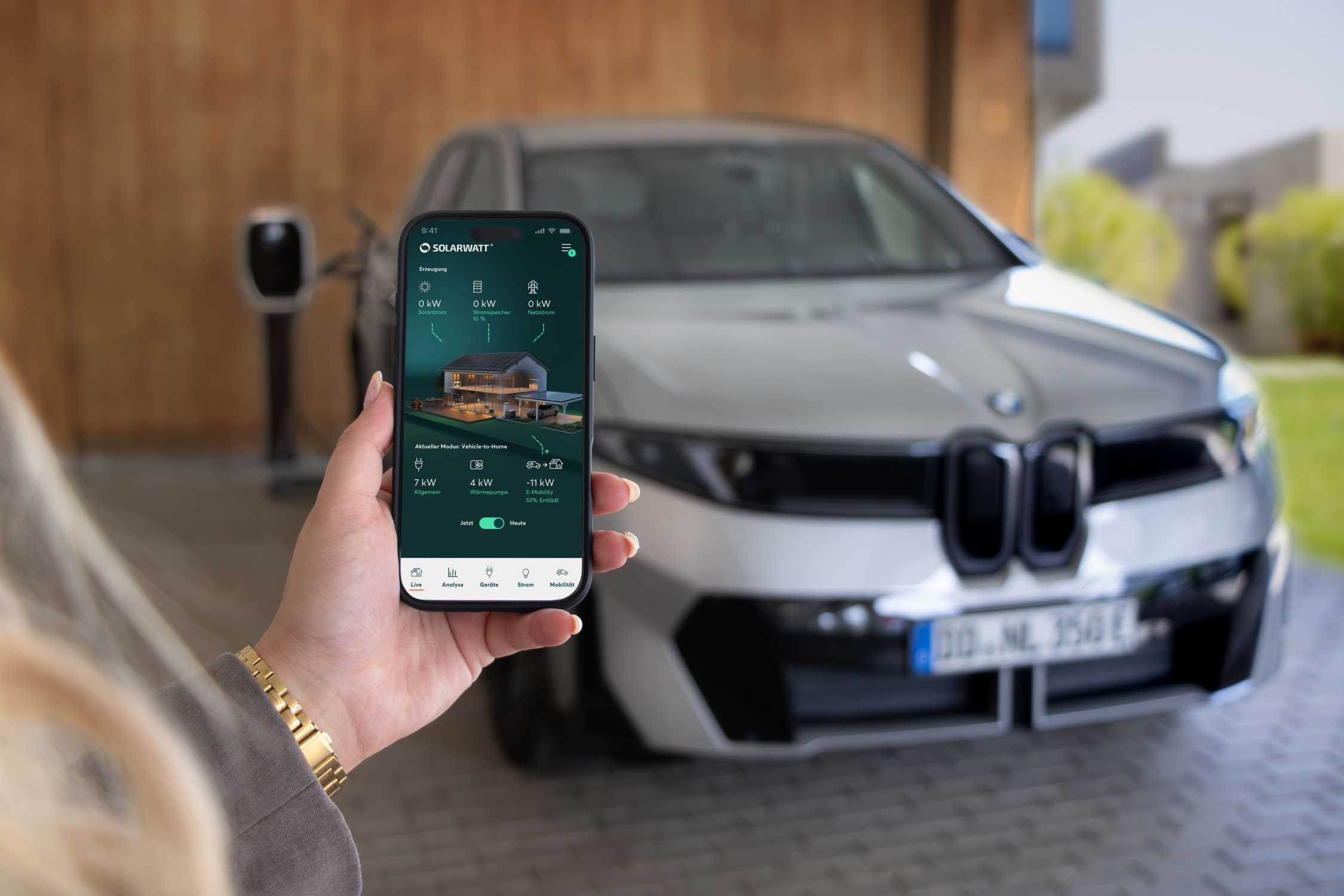
BMW and SOLARWATT have moved their vehicle-to-home (V2H) partnership from broad intent to a more defined technical and commercial plan. In a 15 June 2026 announcement, the companies said they were presenting a system that connects Neue Klasse electric vehicles, a bidirectional BMW Wallbox Professional and the SOLARWATT Manager home-energy management system (HEMS).
The announcement matters because it places an electric vehicle inside a wider household energy system. The vehicle is not only treated as a transport asset: when the required hardware and software are present, its battery can also act as additional storage for the home. BMW and SOLARWATT describe the arrangement as V2H, because the energy is used within the household rather than exported to the public grid.
What the companies have announced
The planned integration is built around three elements. The first is a compatible Neue Klasse vehicle. The second is BMW’s bidirectional Wallbox Professional, which can both charge the vehicle and send stored energy back into the home. The third is SOLARWATT Manager, which coordinates the vehicle with a photovoltaic system, a stationary home battery and other household loads.
That coordination is the central change. Instead of treating the car, solar panels and home battery as separate devices, the HEMS is intended to manage them as one energy network. The system can use solar forecasts to plan charging and can incorporate dynamic electricity tariffs, according to the companies. BMW and SOLARWATT say the aim is to increase the share of self-generated solar electricity used in the home and reduce the need for manual intervention.
The distinction between V2H and V2G is important. V2H keeps the energy inside the customer’s property. V2G, by contrast, sends electricity back to the public grid and depends on a different set of utility arrangements, tariffs and grid approvals. The June announcement does not present the SOLARWATT integration as a public-grid service. It describes a household energy-management application, with the electric vehicle operating as an additional storage unit.
Timing and market scope
BMW and SOLARWATT said the combined offering was being presented at The smarter E and Intersolar Europe 2026 in Munich. The companies set out a planned market launch for late 2026 in Germany, Austria and the Netherlands. The release also said orders for the BMW Wallbox Professional would open through SOLARWATT from the exhibition, while delivery of the wallbox was scheduled for the fourth quarter of 2026.
Those dates describe the companies’ announced rollout, not a universal availability claim. The geographic scope is limited in the release, and the system depends on a specific combination of vehicle, wallbox and HEMS. BMW and SOLARWATT also said that the SOLARWATT Manager could be retrofitted into existing installations, but that does not mean every existing electric vehicle, charger or solar installation will be compatible.
Why the announcement is significant
Home energy systems are becoming a more relevant part of the electric-mobility story as vehicles spend most of their time parked and connected to charging equipment. A bidirectional vehicle can potentially absorb surplus solar generation during the day and make some of that stored energy available to household consumers later. That can change the role of the car from a device that only draws electricity into one that participates in a broader pattern of generation, storage and use.
It also shows where the practical boundary lies. The announcement is not a claim that every EV owner can immediately use a vehicle as a home battery. It identifies the hardware, software and market conditions required for one specific ecosystem. It does not publish a universal savings figure, a guaranteed backup duration or a single price for the complete installation. Those details would depend on the vehicle, household demand, solar production, tariff structure and local installation requirements.
BMW and SOLARWATT have worked together on electric mobility and home storage since 2013, according to the release. Their new plan extends that relationship into a more integrated energy-management model, with the car, wallbox, solar system and stationary storage coordinated through software. The next milestone is the planned late-2026 rollout in the three named European markets. Until then, the announcement remains a roadmap for a defined V2H system rather than evidence of broad, market-wide interoperability.
For the wider electric-mobility sector, the development is a useful marker: vehicle batteries are increasingly being discussed not only in terms of driving range, but also in terms of how they can interact with homes and energy infrastructure. The value of that promise will ultimately depend on transparent specifications, compatible equipment, clear local rules and real-world performance once the system is operating at scale.