
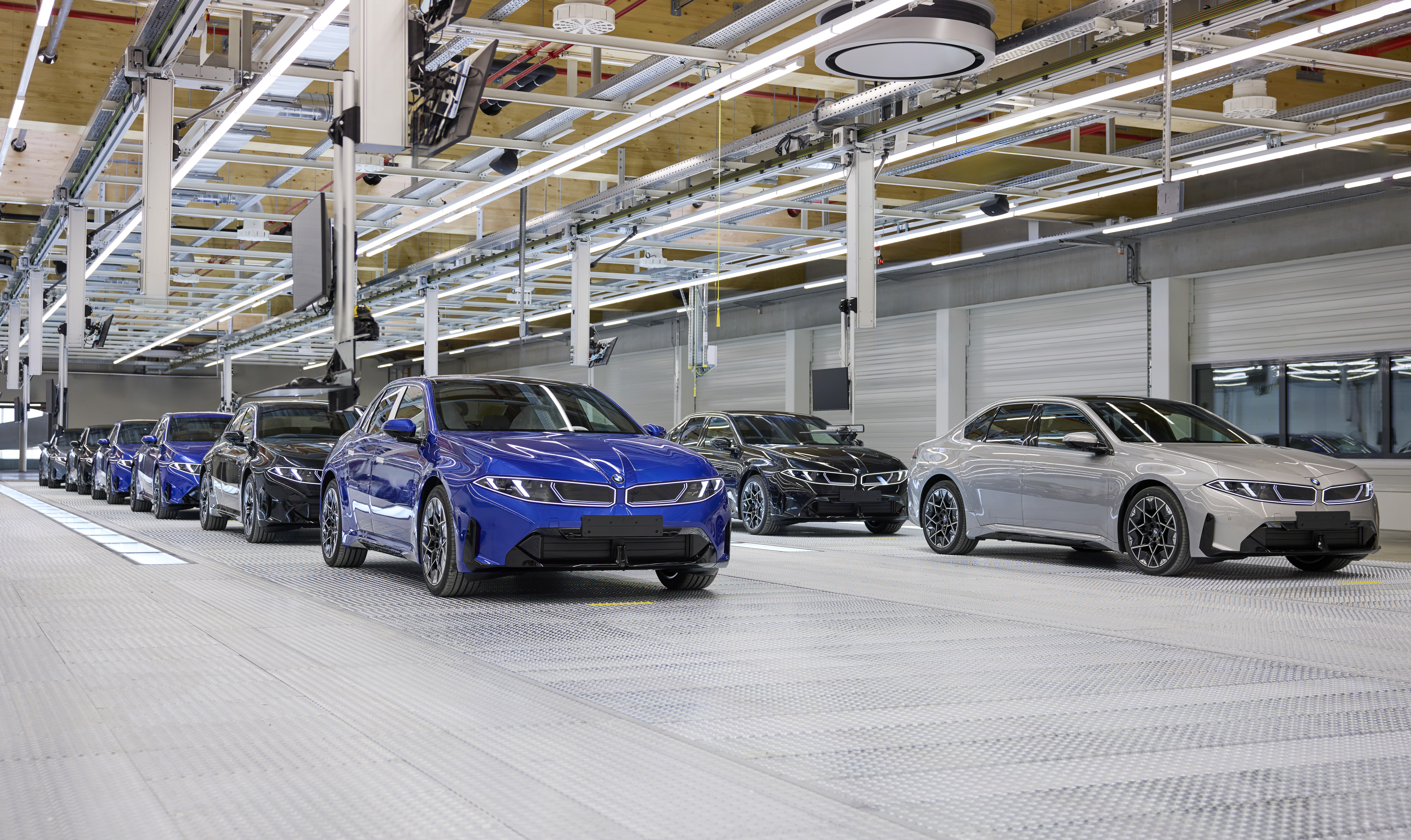
BMW has started series production of the new fully electric BMW i3 at its main plant in Munich, bringing the brand’s Neue Klasse strategy into one of its most historically important factories. The production launch gives BMW a second Neue Klasse model after the iX3 and places the electric 3 Series successor at the centre of the company’s European manufacturing transition.
According to BMW’s official PressClub announcement, the new i3 has been available to order since mid-June. BMW says early demand has created a steep ramp-up curve, although the company has not published an order total or a customer delivery timetable in the announcement.
A four-year transformation at BMW’s historic plant
The production start follows four years of work at Plant Munich, carried out while the factory continued building vehicles. BMW has added a new body shop, a modern vehicle assembly area and expanded logistics facilities across roughly one-third of the site. The changes are intended to make the plant more flexible, digital and efficient while supporting the manufacturing requirements of battery-electric vehicles.
BMW says the launch of the i3 reduces manufacturing costs at the Munich plant by a further 10 percent. The company attributes that improvement to redesigned production processes, targeted automation, digitalisation, integrated logistics and the Neue Klasse vehicle architecture. The announcement does not provide a standalone cost breakdown, so the figure should be understood as BMW’s own manufacturing comparison rather than an independently audited production-cost study.
Munich has a particularly strong connection with the model line. BMW says the plant has built more than nine million 3 Series vehicles since production began there in 1975. Moving the electric i3 into the same location links BMW’s most recognisable compact executive nameplate with the factory that has long represented the core of its brand.
Munich is preparing for an all-electric future
The most consequential part of the announcement is BMW’s plan for the site from 2027. Plant Munich is scheduled to produce only fully electric vehicles from that point onward. BMW says further Neue Klasse models will follow, but it has not identified all of those future products or provided a complete production schedule.
The move is also part of a wider regional manufacturing network. High-voltage batteries for Neue Klasse models, including the i3, are planned to come from BMW’s Irlbach-Straßkirchen facility in Lower Bavaria. BMW describes this as a local-for-local approach designed to increase regional value creation and shorten the relationship between battery production and vehicle assembly.
Electric drive components for the i3 will come from BMW Group Plant Steyr in Austria. The site is producing its first electric motor portfolio, including the rotor, stator, power converter and transmission. BMW also says that new cleanroom environments and production lines have been installed there for the integrated drive unit, while aluminium motor housings are supplied by Plant Landshut.
What BMW has confirmed about the car
BMW’s announcement focuses on manufacturing rather than a full vehicle launch specification. It does list provisional data for the BMW i3 50 xDrive: energy consumption of 16.1 to 13.4 kWh per 100 kilometres and a WLTP range of 758 to 912 kilometres. Those figures are marked as provisional by BMW and can vary with equipment, tyres, weather, driving style, route, charging conditions and auxiliary electrical use. They should not be treated as independent real-world test results.
The production architecture also reflects BMW’s broader Neue Klasse technology programme. The company says battery manufacturing will use inline quality control, digital twins and artificial intelligence, while the Munich plant combines automation and digital production systems with the existing workforce. That combination matters because the transition to electric vehicles is not only a question of installing batteries and motors; it also requires factories to handle new component flows, software-controlled processes and different quality checks.
BMW’s Munich announcement therefore describes more than the arrival of another electric model. It shows the company converting a long-established combustion-era production hub into a dedicated battery-electric site, with local battery and motor supply chains supporting the change. The next test will be the speed and consistency of the ramp-up as customer demand becomes visible in actual deliveries, but the manufacturing milestone itself is now confirmed.