
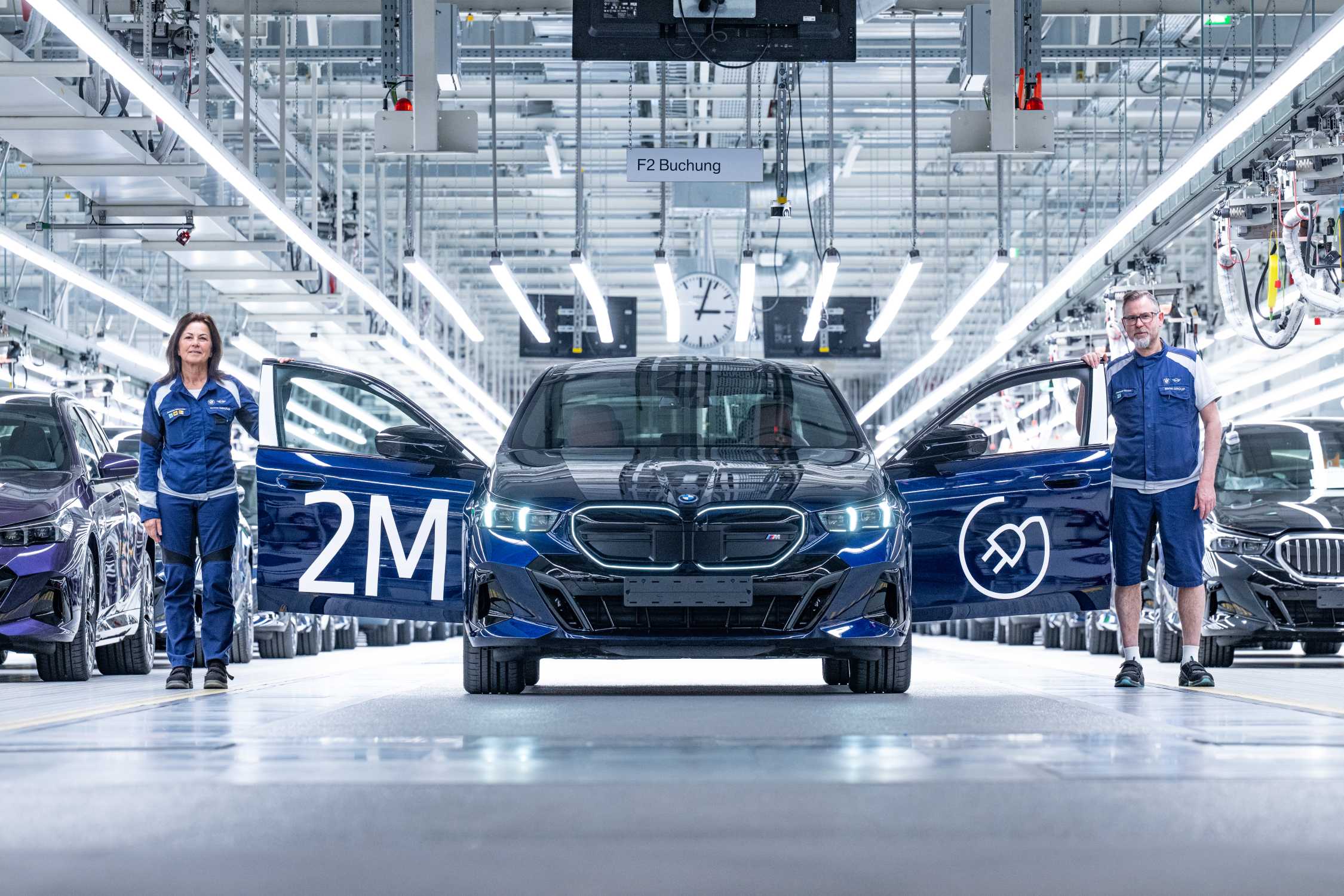
BMW says it has produced its two-millionth all-electric vehicle, marking a manufacturing milestone for the group’s battery-electric programme. The vehicle identified in the company’s official announcement is a BMW i5 M60 xDrive sedan assembled at Plant Dingolfing in Germany. BMW says the anniversary car is destined for a customer in Spain.
The announcement is useful because it gives a concrete production figure, a named plant and a specific vehicle. It is also a company-reported milestone, not an independently audited industry statistic. That distinction matters: the release confirms what BMW says it has built, but it does not establish the group’s market share, profitability or total environmental impact.
What BMW has confirmed
BMW’s statement is dated May 5, 2026, and describes the i5 as the group’s two-millionth all-electric vehicle. The wording refers to battery-electric vehicles, or BEVs, rather than to the broader category of electrified cars that also includes plug-in hybrids. The milestone therefore concerns vehicles powered exclusively by electricity at the point of use.
The release identifies Dingolfing as the site where the milestone vehicle was built. BMW says the plant began series production of all-electric automobiles in 2021 with the BMW iX. It currently produces the BMW iX, the BMW i5 sedan and Touring, and the BMW i7. According to the company, more than 320,000 all-electric vehicles have been built at Dingolfing since that start.
Why Dingolfing is central to the story
BMW presents Dingolfing as the group’s largest German location for a range of all-electric models. On the company’s figures, the plant has produced almost one in six of BMW Group’s two million BEVs. BMW also says that more than a quarter of the vehicles produced at Dingolfing in 2025 were all-electric.
Those figures show how the group’s transition is being absorbed into an existing industrial network. The milestone was not presented as the opening of a dedicated battery-electric factory. Instead, BMW described Dingolfing as part of a production system that can assemble different powertrains within the same broader manufacturing structure.
A mixed-production strategy
BMW calls this approach technology-open production. In practical terms, the company says vehicles with different powertrains can be built in a mixed configuration on a single production line. The release frames that flexibility as a way to keep factories adaptable while demand and regulation continue to change.
BMW also says that, for several years, at least one all-electric model has been produced at every German BMW Group plant. That is BMW’s description of its own network, not a claim that every facility is dedicated to BEV production. The distinction is important: the announcement is about integrating electric vehicles into established operations, rather than declaring a complete conversion of the group’s factories.
What the two-million figure does and does not show
The number provides a clear measure of cumulative production. It indicates that BMW has moved beyond pilot-scale electric manufacturing and has built a substantial volume of BEVs across its production network. It also places the i5 milestone in the context of several model lines rather than a single vehicle programme.
However, the figure is not a sales result. BMW does not use the announcement to report how many of those vehicles remain on the road, how quickly they were sold, or how demand differs between markets. The statement also does not provide a breakdown of production by region, battery capacity, vehicle use or customer type. Those questions require separate sales, fleet and lifecycle data.
The release likewise does not claim that battery-electric production has replaced combustion-engine production throughout the group. Its central message is flexibility: different drivetrains can continue to share manufacturing infrastructure. That makes the milestone relevant to the industrial side of electric mobility, but it should not be read as a timetable for the end of combustion vehicles across BMW’s entire portfolio.
The wider significance for electric mobility
For the electric-car market, the announcement illustrates how established manufacturers are measuring the transition through factory output as well as new model launches. A cumulative production milestone is less immediate than a new vehicle reveal, but it offers a view of whether electric technology is being incorporated into repeatable, high-volume operations.
Dingolfing’s role also highlights a recurring feature of the automotive transition: electrification is not only a question of battery chemistry or vehicle range. It involves factory layouts, workforce training, supply chains and the ability to produce different powertrains without losing operational flexibility. BMW’s release focuses on that manufacturing architecture.
The bottom line
BMW’s two-millionth all-electric vehicle is a verified company announcement about production, not a consumer buying recommendation or a product test. The confirmed facts are specific: BMW identifies a Dingolfing-built i5 M60 xDrive as the milestone vehicle, says it is headed to Spain, and reports more than 320,000 BEVs built at Dingolfing since 2021.
The broader conclusion should remain measured. The milestone demonstrates the scale BMW says its BEV manufacturing has reached, while the company’s technology-open strategy shows that electric production is being added within a mixed-powertrain network. It does not, on its own, answer how profitable the programme is, how quickly customers are adopting the vehicles or how the group’s total emissions are changing.