
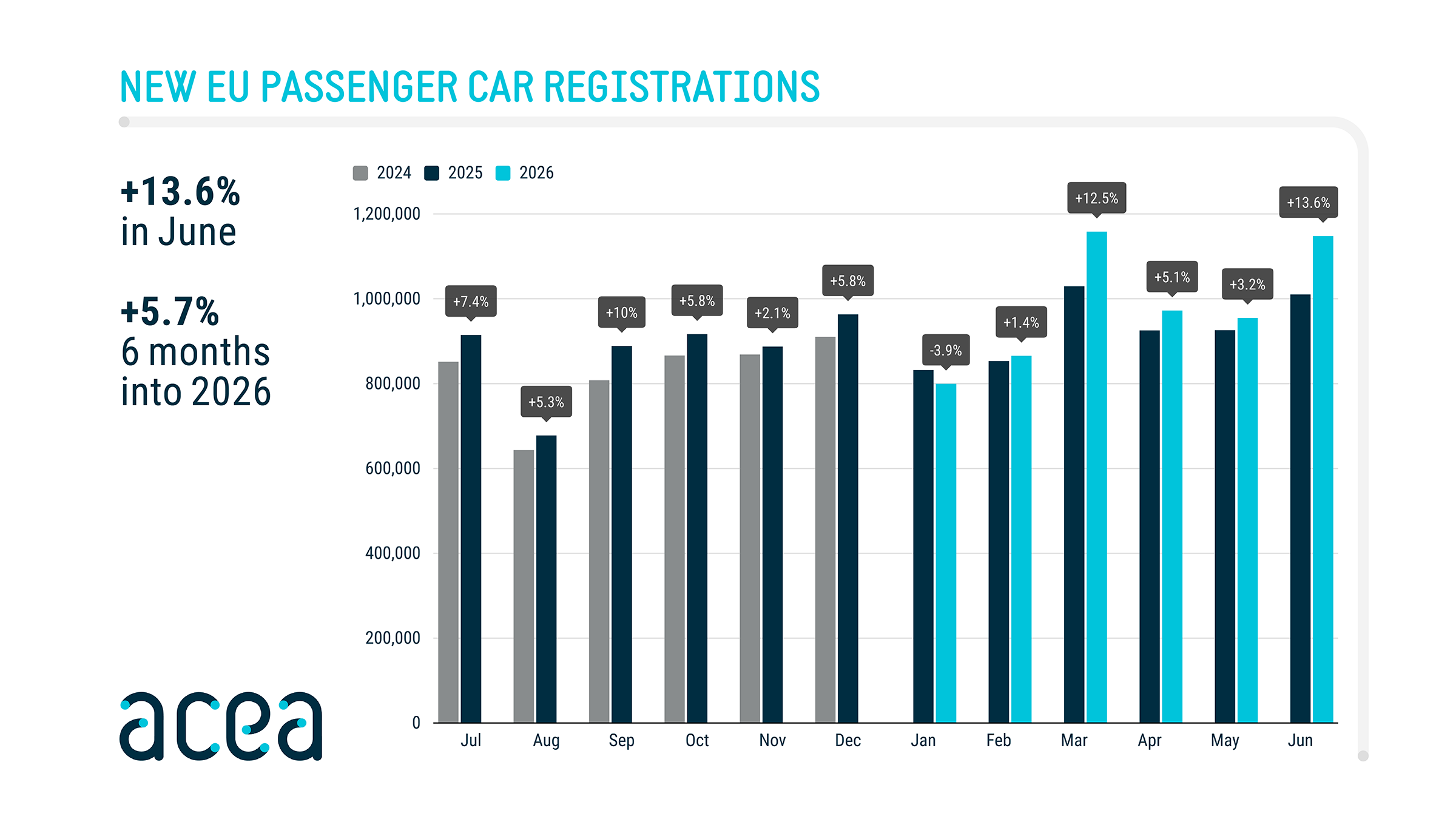
Battery-electric cars accounted for 20.7% of new European Union car registrations in the first half of 2026, according to registration data published by the European Automobile Manufacturers’ Association (ACEA) on 23 July. The figures show a clear year-on-year increase in the share of fully electric cars, but they also confirm that hybrid vehicles remain the most popular powertrain category across the EU.
ACEA recorded 1,220,890 new battery-electric cars between January and June, giving them a 20.7% market share compared with 15.6% during the same period in 2025. Overall new-car registrations increased by 5.7% year to date, with June contributing to what ACEA described as a positive first half despite continuing geopolitical pressure on the market.
Battery-electric growth was concentrated in major markets
The strongest increases came from several of the EU’s largest automotive markets. France recorded a 62.9% rise in battery-electric registrations, Germany grew by 48%, and Denmark increased by 41.2%. Belgium also registered an increase, although its 8.2% growth was more moderate. Together, the four markets accounted for 63% of all new battery-electric registrations in the EU during the first six months of the year.
These figures describe registrations rather than vehicle orders, production volumes or future sales expectations. They also do not establish why individual consumers chose an electric car. ACEA said the market benefited from robust demand for several electrified technologies, with market support measures playing an important role, but the release does not provide a single cause that explains the performance in every country.
Hybrids still lead the powertrain mix
Battery-electric cars did not hold the largest share of the EU market. Hybrid-electric vehicles remained the preferred choice, with 2,198,148 registrations and a 37.3% share. Plug-in hybrid registrations reached 577,735 units, equivalent to 9.8% of the market. Combined, these figures show that electrified powertrains represented a substantial majority of new registrations even though non-plug-in hybrids remained ahead of battery-electric cars.
The distinction matters because hybrid-electric and plug-in hybrid vehicles are not interchangeable with battery-electric cars. Conventional hybrids cannot be charged from the grid, while plug-in hybrids combine a rechargeable battery with an internal-combustion engine. ACEA’s dataset groups these technologies within the wider shift toward electrification, but it reports their market shares separately.
Petrol and diesel continued to lose ground
Petrol registrations fell by 17.2% during the first half of 2026, leaving petrol cars with a 22.2% share of new EU registrations, down from 28.4% a year earlier. Diesel registrations declined by 16.5% and represented 7.5% of the market, compared with 9.4% in the first half of 2025.
Combined petrol and diesel cars accounted for 29.7% of new registrations by the end of June, down from 37.8% a year earlier. That change does not mean every combustion-powered vehicle is being replaced by a battery-electric model: the data shows that hybrids are absorbing a significant part of the market transition. It does, however, indicate that the balance of new-car demand is moving away from conventional petrol and diesel powertrains.
What the figures establish
The first-half data provides a timely snapshot of the EU’s new-car market at a moment when electric mobility is expanding unevenly across technologies and countries. Battery-electric registrations increased strongly in several key markets, while plug-in hybrids also grew and conventional powertrains declined. The overall result is a more electrified market, but not one dominated by a single technology.
Readers should also consider the source’s position. ACEA represents 17 major Europe-based car, van, truck and bus manufacturers, so its registration reporting is an industry dataset and its policy framing reflects the association’s interests. The underlying figures remain useful for tracking market movement, but they should not be read as an independent forecast of future demand or as evidence that the same trend applies uniformly outside the EU.
ACEA’s accompanying official press-release document supplies the detailed registration totals and comparisons used here. For the electric-mobility sector, the main signal is straightforward: battery-electric cars are now one-fifth of new EU registrations, hybrids remain ahead, and the conventional petrol-and-diesel share is continuing to shrink.