
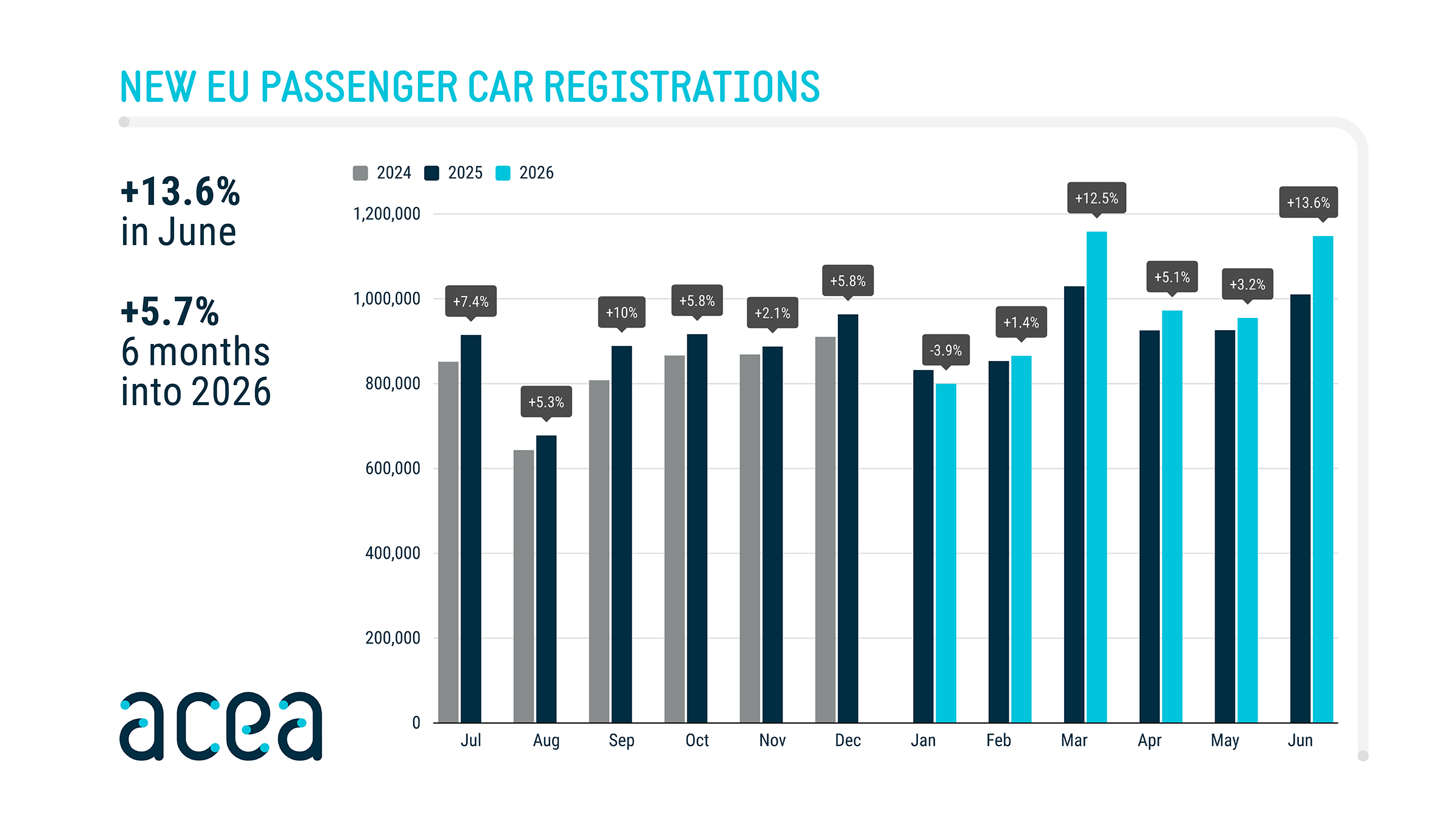
The European Union’s new-car market grew in the first half of 2026, while battery-electric vehicles captured a markedly larger share of registrations than they did a year earlier. The figures, released by the European Automobile Manufacturers’ Association (ACEA) on 23 July, offer a current snapshot of electric-mobility demand across the EU rather than a forecast or a model-by-model ranking.
ACEA reported that new EU car registrations rose 5.7% year to date through June. Within that market, battery-electric cars reached a 20.7% share, up from 15.6% in the first half of 2025. The association recorded 1,220,890 new battery-electric registrations during the six-month period. Its full H1 2026 registration release places the result in the broader context of a market still shaped by several electrified powertrains.
ACEA’s accompanying graphic adds short-term context to the half-year result: June registrations were 13.6% higher than in June 2025, while the first six months together were 5.7% above the comparable period. That distinction matters because a strong final month can lift a half-year result without showing that demand moved evenly from January through June. The release itself highlights June’s contribution to the positive first half.
Battery-electric growth is concentrated in key markets
Three of the four largest EU markets for battery-electric registrations recorded strong year-on-year growth. France was up 62.9%, Germany rose 48% and Denmark increased 41.2%. Belgium also grew, although at a more moderate 8.2%. Together, the four markets accounted for 63% of all battery-electric registrations in the EU during the first half of the year.
Those figures matter because they show that the 20.7% share was not produced by one isolated national result. At the same time, the distribution is uneven. ACEA’s figures describe registration volumes and market shares; they do not establish that the same growth rate will continue across every country or that all parts of the charging network are expanding at the same pace.
Hybrid vehicles still lead the powertrain mix
Battery-electric cars were not the largest electrified category in the EU market. Hybrid-electric vehicles accounted for 37.3% of registrations, with 2,198,148 units registered in the first half. ACEA said hybrid demand was supported by growth in Italy and Spain, as well as increases in Germany and France.
Plug-in hybrids added another 9.8% of the market, equivalent to 577,735 registrations. Their growth was particularly pronounced in Italy, where registrations rose 84.3%, and in Spain, where they increased 39%. Germany recorded a 17.9% increase. These figures should be kept separate from the battery-electric total: a plug-in hybrid can be charged externally, but it is not a battery-electric car.
The shift is also visible in the declining share of conventional powertrains. Petrol cars represented 22.2% of new EU registrations through June, down from 28.4% in the same period of 2025. Diesel cars accounted for 7.5%, compared with 9.4% a year earlier. Petrol registrations fell 17.2% and diesel registrations declined 16.5%, according to ACEA.
What the release confirms
The release confirms that electric cars gained ground in the EU’s new-car market during the first half of 2026. It also shows that the transition is not a simple switch from combustion engines to one alternative: conventional hybrids remain the most common powertrain, plug-in hybrids are expanding in several markets and battery-electric adoption is rising from a lower base.
ACEA attributed the market’s performance to robust consumer demand for a range of electrified technologies, driven primarily by market support measures. That is the association’s explanation for the pattern, not an independent causal finding in the registration table. The data do not identify which incentives, vehicle prices, charging conditions or fleet decisions influenced each national result.
Why the next releases will matter
For readers tracking electric mobility, the important baseline is now clear: one in five new cars registered in the EU during the first six months of 2026 was battery-electric, while electrified powertrains collectively represented a much larger share. The next monthly and quarterly releases will show whether the first-half gains hold across more markets and whether battery-electric growth continues to outpace the wider car market.
Until then, the ACEA release is best read as a measured market update. It records what was registered, where the strongest battery-electric growth occurred and how the powertrain mix changed. It does not by itself prove that electric cars have reached a uniform tipping point across the EU, nor does it provide a buying recommendation. Its value is the clarity of the latest comparable registration data.
