
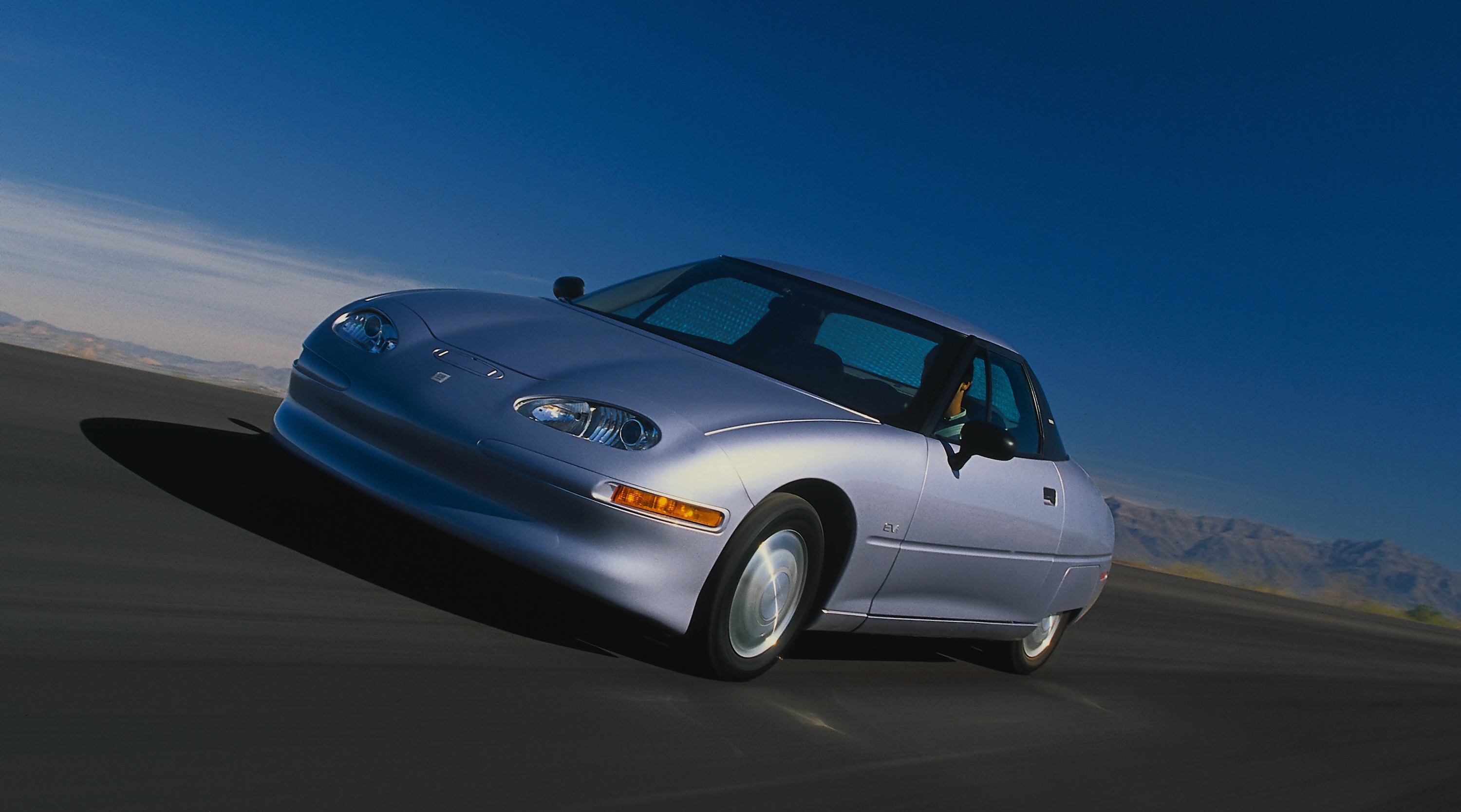
General Motors says it is supporting an independent effort to restore a GM EV1, the electric car that became one of the most closely watched chapters in the company’s early electrification history. The announcement matters as a piece of verified automotive history, not as a return of the EV1 to the consumer market.
In a March 11, 2026 report published by GM News, the automaker said it is aiding Questionable Garage’s restoration of EV1 VIN 212. The car was bought at auction for more than $100,000 after turning up at a Georgia impound lot. GM described the sale as the first public sale of an EV1, a model that was originally leased rather than sold.
What GM is supporting
The restoration is being run independently by private enthusiast Billy Caruso, his father Big Mike, enthusiasts Daren and Freddie Murrer, and Jared Pink, founder of Questionable Garage. Their project, called Project V212, aims to return the car to driving condition and public visibility in time for the EV1’s 30th anniversary in November 2026. That is a stated goal and timetable, not a result: GM has not said that the car is already roadworthy.
GM says its support includes access to parts removed from a donor EV1. The components were carefully disassembled by the company’s design fabrication team at GM’s Global Technical Center in Warren, Michigan. The restoration team also met engineers and program managers who worked on the original EV1, as well as GM Heritage Center experts Adam King and Kevin Kirbitz.
The visit gave the project access to the company’s historical material, including the Electrovair II, the Sunraycer solar race car and the 1990 Impact concept that previewed the EV1. GM also showed the team its work to recommission EV1 number one. The company’s account makes the boundary clear: this is technical and heritage support for a private restoration, not a new production programme.
Why the EV1 still matters
GM’s report places the EV1 in a longer line of electric experiments. The 1990 Impact concept evolved into the EV1, with the first cars reaching lessors in late 1996. GM says it leased around 1,000 vehicles built at a special facility in Lansing, Michigan. Because the cars were leased and later recalled, surviving examples have generally remained non-drivable displays in museums and universities.
The car’s importance was not only its battery power. It was designed from the ground up as an electric vehicle, with aerodynamics and mass reduction treated as central engineering problems. GM highlights a heat pump for climate control, a blended regenerative and friction-braking system, electronic controls for several driver inputs, low-rolling-resistance tyres and an aluminium space-frame chassis.
Those features are useful context for understanding why the EV1 continues to appear in modern electrification discussions. They show that many current EV priorities—efficiency, regenerative braking, electronic control and careful use of weight—were already being explored in a purpose-built vehicle decades ago. They do not prove that the EV1 was equivalent to a modern electric car, however. Battery chemistry, charging infrastructure, safety requirements and software have all changed substantially, and GM’s article does not provide a modern performance comparison.
A restoration, not a product launch
The most important qualification is also the easiest to lose in a nostalgic story: the EV1 is not being relaunched. GM’s announcement concerns a privately owned historic vehicle and a restoration project. It gives no price, sales plan, replacement-battery programme or consumer availability. It also does not establish that EV1 VIN 212 will meet current road-legal or safety requirements once the work is complete.
That distinction keeps the news in proportion. GM is preserving and helping document a vehicle that the company says helped set the direction for its later electric work. Project V212 may eventually put a rare EV1 back in motion, but the only confirmed milestone today is the collaboration itself and the stated target of showing the restored car around the 30th anniversary.
For an industry now measuring EV progress in charging networks, battery plants and software updates, the EV1 story offers a different kind of evidence. It connects current engineering ambitions to an earlier experiment and makes the preservation of that experiment visible. The next meaningful update will be whether the restoration team can complete the work and demonstrate the car publicly; until then, the project remains a documented restoration effort rather than a consumer launch.