
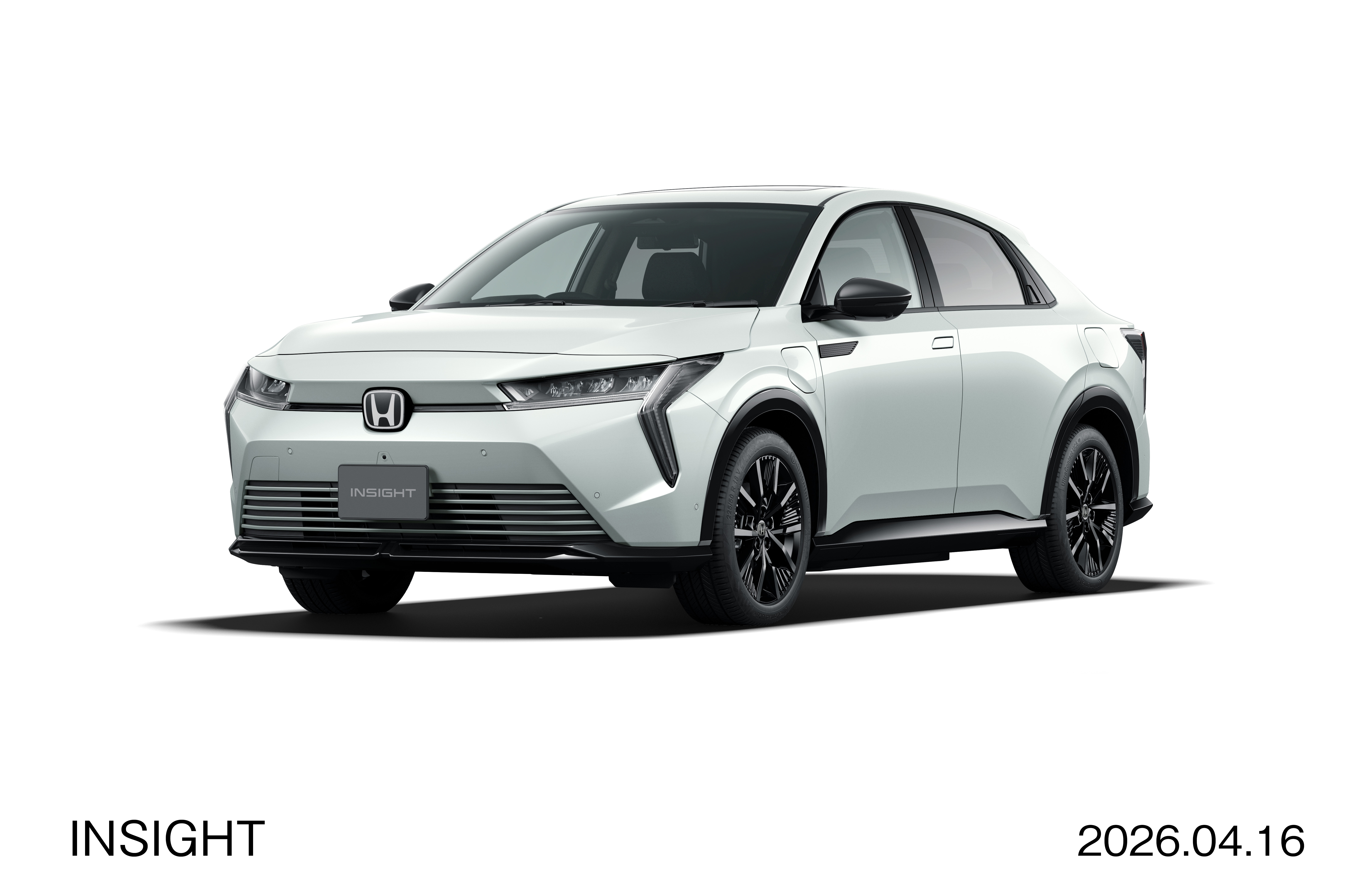
Honda has announced the Japanese launch of an all-new Insight battery-electric vehicle, repositioning a name long associated with hybrid technology as a crossover passenger EV. In its April 16, 2026 news release, Honda said sales would begin in Japan on April 17.
The announcement is specific to Japan. Honda said the model would be offered in a limited quantity of 3,000 units, but it did not announce sales plans for other markets. That distinction matters: the release confirms a domestic launch rather than a global rollout or a general timetable for international availability.
A new role for the Insight name
The fourth-generation Insight is described as a newly developed crossover SUV EV. Honda says the vehicle was designed from the outset as an electric model, with a distinctive exterior and an interior intended to give all occupants a more spacious and comfortable environment. The original Insight, introduced in 1999, was Honda's first mass-produced hybrid model. The new vehicle therefore carries a familiar name into a different phase of the company's electrification strategy.
Honda's official figures give the Insight a claimed driving range of 535 kilometres, or 332 miles, under Japan's WLTC test cycle. The company says fast charging takes approximately 40 minutes to reach 80 percent from the point at which the low-charge warning appears, using a charger with output above 50 kW. Honda also cautions that charging can take longer in summer and winter conditions. These are manufacturer-published figures, not independent real-world measurements.
Charging and external power
The Insight also supports external AC power output of up to 1,500 watts through Honda's Power Supply Connector. Honda identifies the connector as a dealer option and says it can be used for outdoor activities away from home. The release does not describe the vehicle as a household backup system, nor does it provide a vehicle-to-grid capability. The confirmed feature is a limited external power function, and it should not be treated as evidence of broader bidirectional charging support.
That distinction is useful for interpreting the announcement. Electric vehicles increasingly sit between transport and energy infrastructure, but capabilities that sound similar can have very different technical and practical meanings. In this case, Honda's release supports a statement about portable AC output, not a claim that the Insight can power a home or participate in grid services.
Comfort and cabin technology
Honda says the cabin was developed around passenger comfort, with elevated sight lines for the driver, a head-up display and a centre console designed to allow movement between the front seats. The rear seats include generous legroom and a reclining function, while the cargo area can be configured with an adjustable luggage board and folding rear seatbacks.
The release also lists an energy-conscious heating system with radiant heater panels, ambient lighting and an aroma diffuser. A Bose premium sound system with twelve speakers is included among the interior features Honda highlights. These details explain how the company is positioning the model, but they are not independent assessments of comfort, efficiency or long-distance usability.
Driver assistance and pricing
The all-new Insight comes with Honda Sensing driver-assistance functions, including collision-mitigation braking, pedestrian collision-mitigation steering, road-departure mitigation, adaptive cruise control with low-speed follow, lane-keeping assistance, traffic-jam assist, traffic-sign recognition, blind-spot information and parking support. Honda explicitly states that these systems are intended to assist the driver and have limits in recognition and control capability. Drivers remain responsible for maintaining attention and operating the vehicle safely.
Honda listed a manufacturer's suggested retail price of 5.5 million yen in Japan, including the country's 10 percent consumption tax. The company notes that the figure is for reference, excludes certain registration-related costs and does not determine the final selling price set by individual sales companies. No price, specification or availability information for markets outside Japan was included in the announcement.
What the announcement confirms
Honda's release establishes three clear points: the Insight has returned as a battery-electric crossover, sales were scheduled to start in Japan on April 17, 2026, and the initial Japanese allocation was limited to 3,000 vehicles. It also provides Honda's official WLTC range, charging estimate, external-power specification and domestic reference price.
It does not establish independent range performance, a global launch plan, current stock levels, or a broader energy-management role for the vehicle. Those questions require separate evidence. For now, the Insight announcement is best read as a verified report of Honda's Japanese EV launch and the specific capabilities the manufacturer has chosen to disclose.