
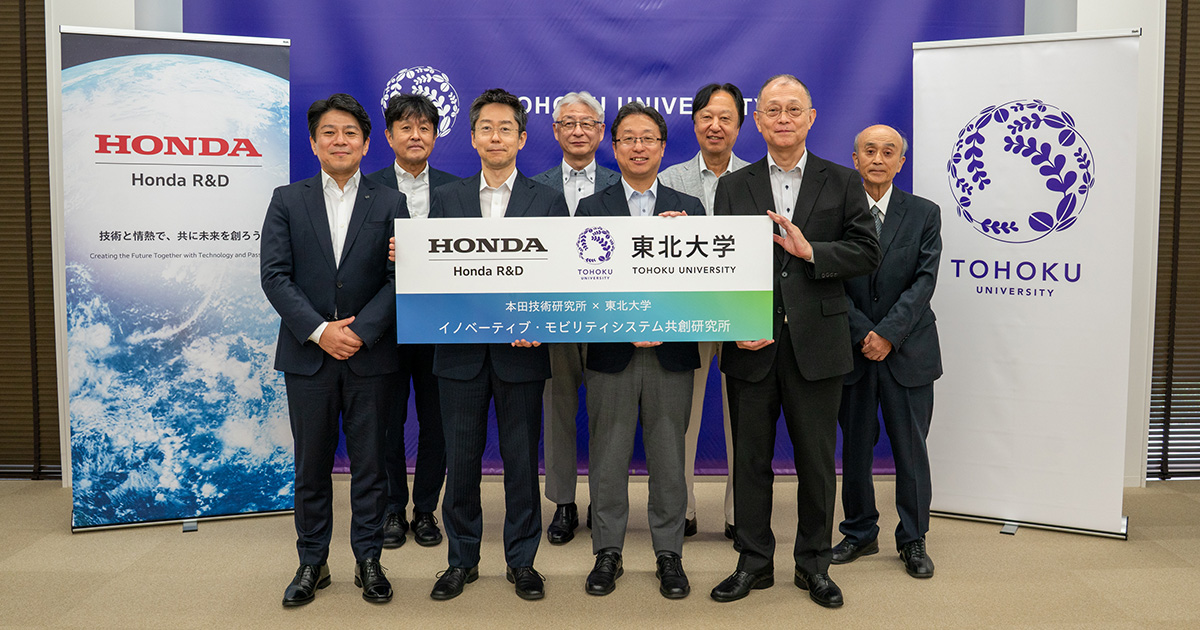
Honda R&D Co., Ltd., Honda Motor Co., Ltd.’s research and development subsidiary, and Tohoku University established a new research center in Japan on September 1, 2026, according to Honda’s announcement. Based at Tohoku University’s Institute of Fluid Science, the center will examine advanced research that could support future mobility systems.
The announcement describes an organizational change, not a new vehicle, service or production program. Honda and the university now have a defined structure for identifying research themes, developing shared strategies and selecting areas for joint research. Honda’s announcement is available at Newsroom.
A formal route from research themes to joint R&D
The partnership combines Tohoku University’s academic expertise with Honda’s technical expertise and know-how. Honda says that this know-how has been accumulated mainly through its work involving mobility products and services, giving the center a direct connection to the company’s existing research capabilities.
The partners will investigate cutting-edge research themes that may contribute to innovation in future mobility systems. Their stated focus is application-oriented research and development. That wording places the emphasis on connecting early-stage exploration with work that could eventually support concrete applications, while leaving the technology itself open at this stage.
The center will draw on more than one part of the university. It is expected to work with various faculties, schools and other university units while exploring deep tech and other advanced research areas. Honda R&D researchers and Tohoku University researchers will use the knowledge generated through that process to formulate research strategies, then conduct joint research on themes selected in line with those strategies.
Honda and Tohoku University also link the effort to addressing societal challenges and creating new value for society. The practical role of the center is therefore to coordinate interdisciplinary work and give selected research a structured path toward possible applications, rather than to announce a finished mobility solution.
The center has a defined operating window
The planned operating period runs from September 1, 2026, through August 31, 2029. Toshiro Kiura, a Fellow at Honda R&D, is the director of research operations. Kaoru Maruta, Tohoku University’s Associate Executive Vice President and a professor at the Institute of Fluid Science, is responsible for operational support. Shigeru Omura, Chief Engineer at Honda R&D’s Research Center of Excellence, is the contact for the participating company.
The center sits within Tohoku University’s wider Co-creation Research Center framework. Established in April 2021, that framework uses the university’s research resources to promote interdisciplinary co-creation. Tohoku University had more than 50 such centers by the end of August 2026, so the Honda collaboration extends an existing institutional model rather than creating a standalone structure outside the university’s broader approach.
What mobility readers should watch next
For the mobility sector, the immediate significance is the formal route connecting Honda’s product and service experience with research capabilities across Tohoku University. The announcement does not identify a specific technology, named vehicle application or deployment schedule, so no direct product change follows from the launch.
The more useful indicators will come from the work carried out during the three-year period: the research themes selected, any named joint projects and any applications that Honda or the university later announce. Those developments would show whether the center is moving beyond coordinated exploration toward a defined mobility use case. Until then, its outcome remains open.
Honda and Tohoku University have established a time-limited research partnership focused on future mobility systems. It gives interdisciplinary research a clear operating structure and an application-oriented objective, but it does not yet promise a particular product or service. The next meaningful evidence will be the themes and projects that emerge from the center’s work through August 2029.