
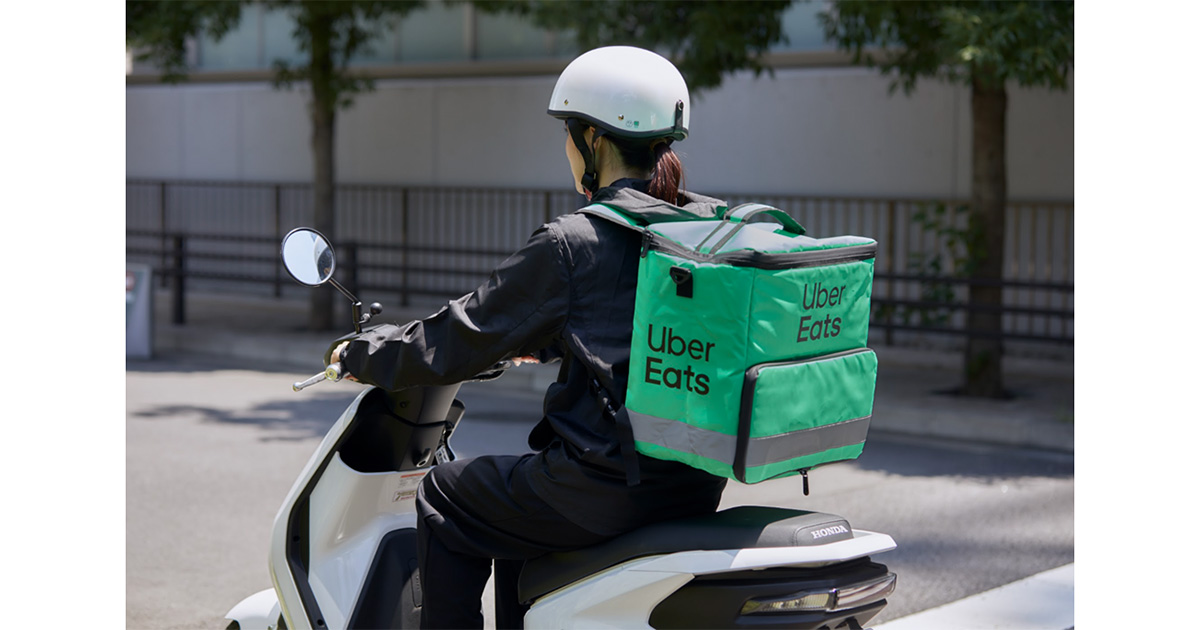
Honda and Uber Eats Japan will hold a demonstration in September 2026 to assess motorcycle delivery riding through a smartphone app and connect the results to Uber Eats' safety incentives. The trial is part of Uber Eats Japan's Safe Driving Campaign and is aimed at motorcycle delivery partners who have requested to participate, according to Honda's announcement on August 31, 2026.
What the app will measure
During deliveries, the app will analyze each participant's riding behavior and display the results as safe-driving scores. The evaluation includes acceleration, braking and steering, making patterns visible that riders may not recognize on their own.
The system is designed to work with different motorcycle models and requires only a smartphone, with no dedicated hardware. Honda says it combines vehicle data accumulated by the company with statistical processing to extract dynamics data that accounts for motorcycle-specific characteristics. The evaluation logic also draws on the expertise of Honda road-safety education instructors and real-world riding data collected by Honda's internal test riders.
Why the test includes incentives
Honda and Uber Eats Japan will combine the visualized evaluation results with Uber's incentive program. The companies are considering score-based rankings and/or other incentive systems intended to encourage riders to develop and maintain safer riding practices.
The demonstration will test whether feedback is more effective when it is connected to a participation or reward structure. Honda and Uber Eats Japan have not reported a measured improvement yet; the stated purpose is to assess whether awareness and riding behavior improve among Uber motorcycle partners.
Scores are for review, not live guidance
The app runs in the background and must not be used while riding. Honda says it should be used only when the vehicle is stopped, so the scores are meant to help riders review their behavior after a ride rather than provide live instructions on the road.
Honda also cautions that the scores do not guarantee safe riding or accident-free operation. A numerical result can make riding behavior easier to discuss, but it cannot by itself establish that a delivery route was safe or that crash risk was eliminated.
A new layer in an existing safety effort
The demonstration builds on an earlier Honda-Uber safety initiative. By May 2026, a motorcycle safety-awareness training resource co-produced by the two companies had been used as a training tool by 500,000 Uber partners in 21 countries. Uber has distributed that content through its app since March 2025. The Japanese trial adds behavior measurement and incentives to that training background.
What changes for participating riders
For motorcycle delivery partners in Japan who choose to join, the immediate change is app-based feedback during deliveries as part of the campaign. Honda and Uber Eats Japan will assess both the app's usability and the effect of pairing scores with incentives, while Honda says broader applications will be explored depending on the results.
For now, the technology remains a demonstration, not a published safety guarantee or a universal requirement for motorcycle delivery riders. Its value will depend on whether the feedback works across different motorcycles and whether the incentive model produces a sustained change in riding behavior.