
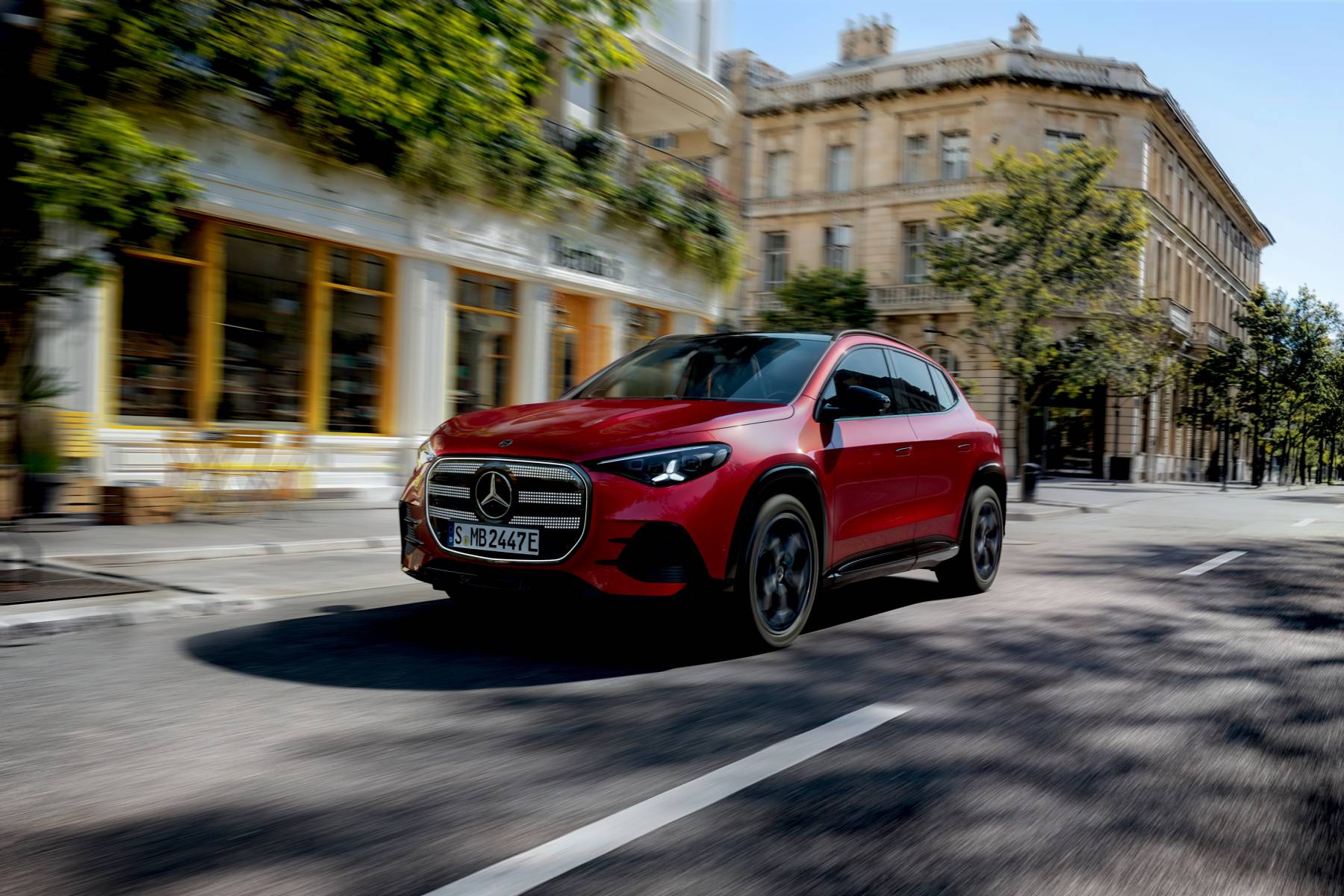
Mercedes-Benz has announced an all-new GLA with three fully electric variants scheduled for market launch in November 2026. The company presented the model on 29 July in an official release, describing it as the first electric version of the compact SUV’s new generation. This report separates the manufacturer’s confirmed specifications and claims from information that would require independent testing.
Three electric versions at launch
According to the Mercedes-Benz announcement, the electric GLA range will initially comprise the front-wheel-drive GLA 200 electric, the GLA 250+ electric and the all-wheel-drive GLA 350 4MATIC electric.
The GLA 200 electric is listed with a 165 kW motor and a lithium iron phosphate battery offering 58 kWh of usable energy. The 200 kW GLA 250+ electric and 260 kW GLA 350 4MATIC electric use nickel-manganese-cobalt batteries with 85 kWh of usable energy. Mercedes-Benz says another model with a 71 kWh NMC battery will follow in early 2027.
The company also says the electric GLA will offer a 107-litre front storage compartment and, on 4MATIC versions, towing capacity of up to two tonnes. Those figures are part of the manufacturer’s technical information and are not independent measurements.
Range and charging figures
Mercedes-Benz quotes a maximum WLTP range of 657 kilometres for the all-electric GLA. WLTP is a standardised test procedure rather than a guarantee of real-world distance. The company itself notes that actual range can vary with driving style, weather, battery age, auxiliary equipment, tyres, payload and route profile.
The release also claims that the electric GLA can add up to 270 kilometres of WLTP range in ten minutes when using the vehicle’s maximum DC charging capability under the stated test conditions. The platform supports 800-volt charging at up to 320 kW. AC charging is rated at up to 22 kW, while an optional converter allows use of 400-volt charging stations.
These figures describe the vehicle’s charging capability, not the outcome of a particular public charging session. Actual charging speed will depend on the charger, battery temperature, state of charge, infrastructure and local conditions. The announcement does not provide independent road testing or a measured charging curve.
A broader compact-SUV strategy
Mercedes-Benz is positioning the electric GLA alongside future electrified combustion variants. The company says those hybrid versions will arrive at the beginning of 2027, initially with front-wheel drive and all-wheel drive. The hybrid system is described as using a newly developed 1.5-litre four-cylinder turbo engine, a 22 kW electric motor and a 48-volt battery with up to 1.3 kWh of energy capacity.
For electric mobility, the more significant part of the announcement is the attempt to combine a compact SUV body with a choice of battery sizes and an 800-volt electrical architecture. The 58 kWh LFP version gives the range a lower-capacity entry point, while the 85 kWh NMC versions are intended to support longer-distance use and higher outputs. Mercedes-Benz has not published a complete market-by-market pricing or delivery schedule in the release.
Digital systems and driver assistance
The new GLA will use Mercedes-Benz’s MBUX Virtual Assistant, which the company says can answer questions about charging points, parking spaces and other destinations. Its navigation system is described as using electric-route planning to include charging stops and adjust routes when traffic or driving conditions change.
The release also describes a package of cameras, radar and ultrasonic sensors supporting lane, distance, braking, acceleration and parking functions. Mercedes-Benz classifies the steering and lane-change assistance as SAE Level 2 assistance. That designation does not make the vehicle autonomous: the company’s own safety note says drivers remain responsible and must observe the system’s limitations and the owner’s manual.
What this announcement confirms
The July announcement confirms Mercedes-Benz’s planned November launch of three electric GLA variants and provides manufacturer-stated battery, power, charging and WLTP figures. It does not establish independent real-world range, long-term reliability, public-charging performance or customer delivery timing beyond the stated market-launch window.
For readers tracking electric mobility, the announcement is therefore best understood as a product and platform update. Its practical significance will depend on market-specific pricing, final availability and independent testing once vehicles reach customers. Until then, the WLTP range and charging numbers should be read as official claims under defined conditions, not as guaranteed everyday results.