
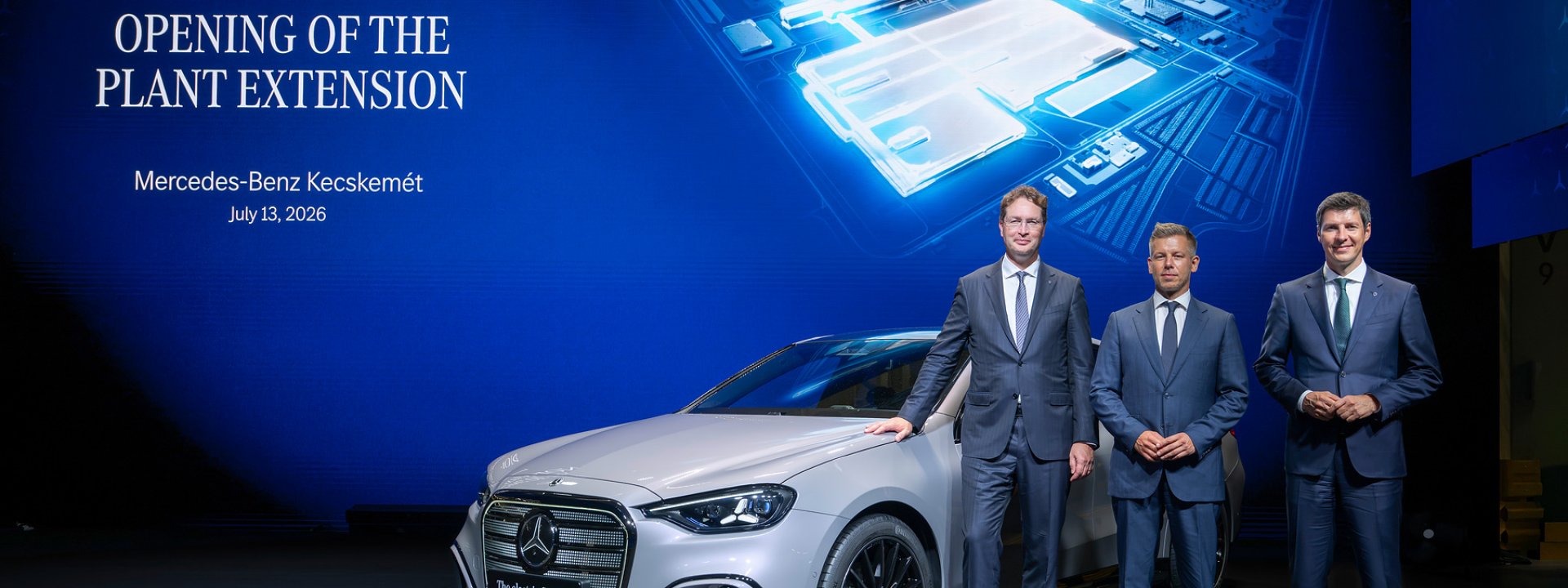
Mercedes-Benz has started production of its new battery-electric C-Class at the company’s expanded Kecskemét plant in Hungary. The move gives the site its first all-electric core model and places battery assembly, vehicle production and a wider factory rebuild at the centre of the announcement. That makes the development relevant beyond the vehicle itself: it is about how an established plant is being retooled for electrification.
According to Mercedes-Benz’s official announcement, the Hungarian facility has been expanded from a footprint of 200 hectares to 440 hectares. The company says the investment, made under its 2022–2026 business plan, totals around €1 billion. The site currently employs more than 5,000 people and is described by Mercedes-Benz as the region’s largest employer.
What the factory is adding
The extension includes two new halls for bodywork and assembly, a second press shop, a new paint shop and a battery assembly facility. Those additions are intended to support a more flexible production network rather than create a single-model plant. Mercedes-Benz says the upcoming more compact version of the G-Class will also be built exclusively at Kecskemét, while the site will be linked with German plants for other programmes.
The industrial change is significant because the new electric C-Class is not being added as a separate pilot line. The company says combustion-engine vehicles and battery-electric models can be built flexibly on one existing line, while the new hall is configured for fully electric production. That arrangement is designed to let output adapt to market demand, although the announcement does not provide production targets or a forecast for the number of electric C-Class vehicles Kecskemét will make.
A local battery and vehicle supply chain
Mercedes-Benz describes the launch as part of a “local-for-local” approach. At Kecskemét, it says key body parts and drive batteries for the electric C-Class and electric GLB are produced on site. Keeping those steps close to final assembly can reduce the distance between suppliers and the factory and give the company more control over how models are allocated across its European network. The announcement presents this as a resilience measure in a volatile market; it does not quantify the resulting logistics or emissions savings.
The plant is also being connected operationally with Mercedes-Benz’s sites in Germany. The company says flexible production links will allow the electric GLC, for example, to be built at both Bremen and Kecskemét according to demand. This is a statement about manufacturing capability and network planning, not a confirmation of a particular market launch schedule or customer delivery date.
Energy and digital systems are part of the expansion
The factory’s energy plan includes a 240,000-square-metre open-space solar park rated at 27.4 MWp. Combined with rooftop photovoltaic systems on the new battery, bodywork and final-assembly halls, Mercedes-Benz says the site will have 42.3 MWp of solar capacity, covering around 25% of its annual energy requirement.
The company also reports that the new paint shop is designed to use around 20% less energy than the existing facility and to cut carbon-dioxide emissions by around 80%. These are manufacturer-reported figures for the production site, not an independently presented lifecycle assessment of the electric C-Class. That distinction matters: the announcement describes factory measures, but it does not establish the vehicle’s total environmental impact.
On the production side, Mercedes-Benz says the site uses its MO360 digital production ecosystem and a digital twin of the entire assembly hall created in NVIDIA Omniverse. The twin is intended to let teams simulate production steps and identify issues before changes reach the physical line. Camera-based quality checks and AI-supported analysis are also cited as tools for detecting defects and reviewing production data.
What this announcement confirms—and what it does not
The confirmed development is a manufacturing milestone: Kecskemét has opened a major extension and begun building Mercedes-Benz’s electric C-Class. It also shows how the company is combining dedicated electric-vehicle infrastructure with flexible lines that can handle different powertrains.
Mercedes-Benz has not announced pricing, customer deliveries, market-by-market availability or a production-volume commitment in this release. Nor does the statement provide independent verification of its energy or emissions claims. For readers tracking the electric-mobility transition, the useful signal is therefore the factory change itself: battery assembly and high-volume EV capability are moving into an established European production site, while the exact commercial impact remains to be reported.