
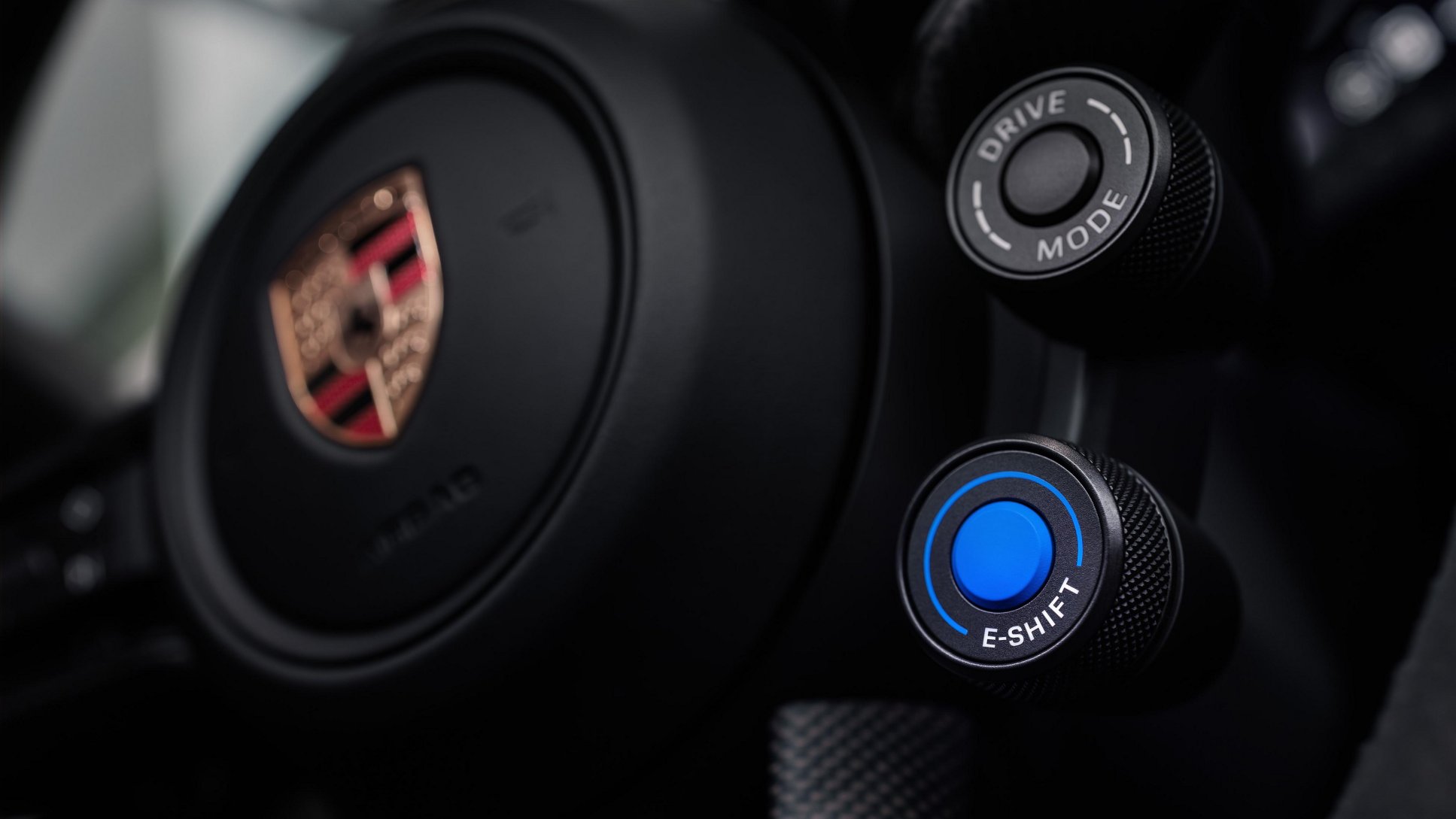
Porsche has announced a new E-Shift option for the electric Taycan, adding simulated gear changes, acoustic feedback and tactile responses to the car’s otherwise seamless electric power delivery. The company presents the feature as a way to make driving more interactive, rather than as a performance upgrade. This article is based on Porsche’s official newsroom announcement.
What Porsche is changing
The E-Shift system is software-based. Porsche says it simulates an eight-speed Porsche Doppelkupplung, or PDK, transmission within the Taycan’s control systems. Drivers can experience virtual gear changes either automatically or manually, using paddles mounted behind the steering wheel.
Each simulated shift is accompanied by several forms of feedback. The system briefly interrupts the otherwise continuous acceleration, adds a rising rev-counter display that reaches 7,500 rpm, and introduces a specially developed sound profile. Porsche describes these details as an effort to recreate some of the cues traditionally associated with a combustion-powered sports car without replacing the Taycan’s electric drivetrain.
Performance is not the stated objective
Porsche is clear that E-Shift is designed to alter the character of the drive rather than make the Taycan faster. During a simulated shift, the system briefly reduces drive torque before restoring it. The company says overall acceleration remains unchanged, even though the driver receives a stronger sense of progression through the virtual ratios.
That distinction matters. Electric motors can deliver torque with very little interruption, which is one of the defining characteristics of an EV. Porsche’s announcement frames E-Shift as a response to the reduced mechanical feedback that comes with that smooth delivery. The option therefore belongs to the growing category of software-defined features that change how an electric vehicle feels without changing its fundamental powertrain output.
Digital controls meet existing hardware
The Taycan already uses a two-speed transmission on its rear axle. Porsche says E-Shift combines that physical hardware with additional virtual ratios. In particular, the transition between the simulated second and third gears is coordinated with the car’s real mechanical gear change. The result is intended to blend a genuine drivetrain event with digitally generated driver interaction.
E-Shift is activated through a switch on the GT-sports steering wheel. From there, the driver can select automatic or manual operation, while the steering-wheel paddles control the virtual changes in manual mode. When E-Shift is switched off, Porsche says the same paddles can be used to adjust recuperation across two stages. Pulling both paddles simultaneously activates the Taycan’s Push-to-Pass function, according to the company.
Sound is part of the system
The announcement gives particular attention to the acoustic layer. Porsche says the enhanced soundscape responds to virtual engine speed, load conditions and road speed. It builds on the Taycan’s Porsche Electric Sport Sound and is delivered through the vehicle’s existing interior and exterior loudspeakers, with a rear-biased character.
This is not intended to reproduce a conventional engine as a purely cosmetic effect. Porsche links the sound to the virtual shift strategy, so the acoustic response changes with the selected ratio and the way the vehicle is being driven. The start-up sequence also receives a new sound, making the feature part of the car’s wider interaction design rather than an isolated audio setting.
What the announcement establishes
Porsche’s announcement establishes three points. First, E-Shift is an option for the electric Taycan that relies on software and existing vehicle hardware. Second, it adds simulated gear changes and coordinated visual, acoustic and tactile feedback. Third, Porsche says the system does not change the car’s overall acceleration performance.
The announcement does not provide a price, market-by-market availability schedule or an independent assessment of how the feature performs in real-world driving. Those details would be needed before making any conclusion about value or customer demand. For now, the confirmed story is narrower: Porsche is using software to introduce a more staged, participatory driving experience into an electric sports car.
That approach illustrates a broader direction for electric mobility. As battery and motor technology make propulsion smoother, manufacturers are increasingly using software to shape the driver’s perception of speed, control and feedback. In the Taycan, Porsche is choosing simulated ratios and shift events as the interface. Whether that adds meaningful involvement will depend on individual preferences, but the company’s stated objective is clear: make electric power delivery feel more interactive while leaving the underlying performance unchanged.