
Porsche’s first-half 2026 results present a mixed picture of the automaker’s electric transition: profitability and automotive cash flow improved, while customer deliveries and the battery-electric share moved lower. The figures come from Porsche AG’s official financial update, which also reaffirms the company’s full-year outlook and sets the next stage of its strategic realignment.
Profit improved even as deliveries declined
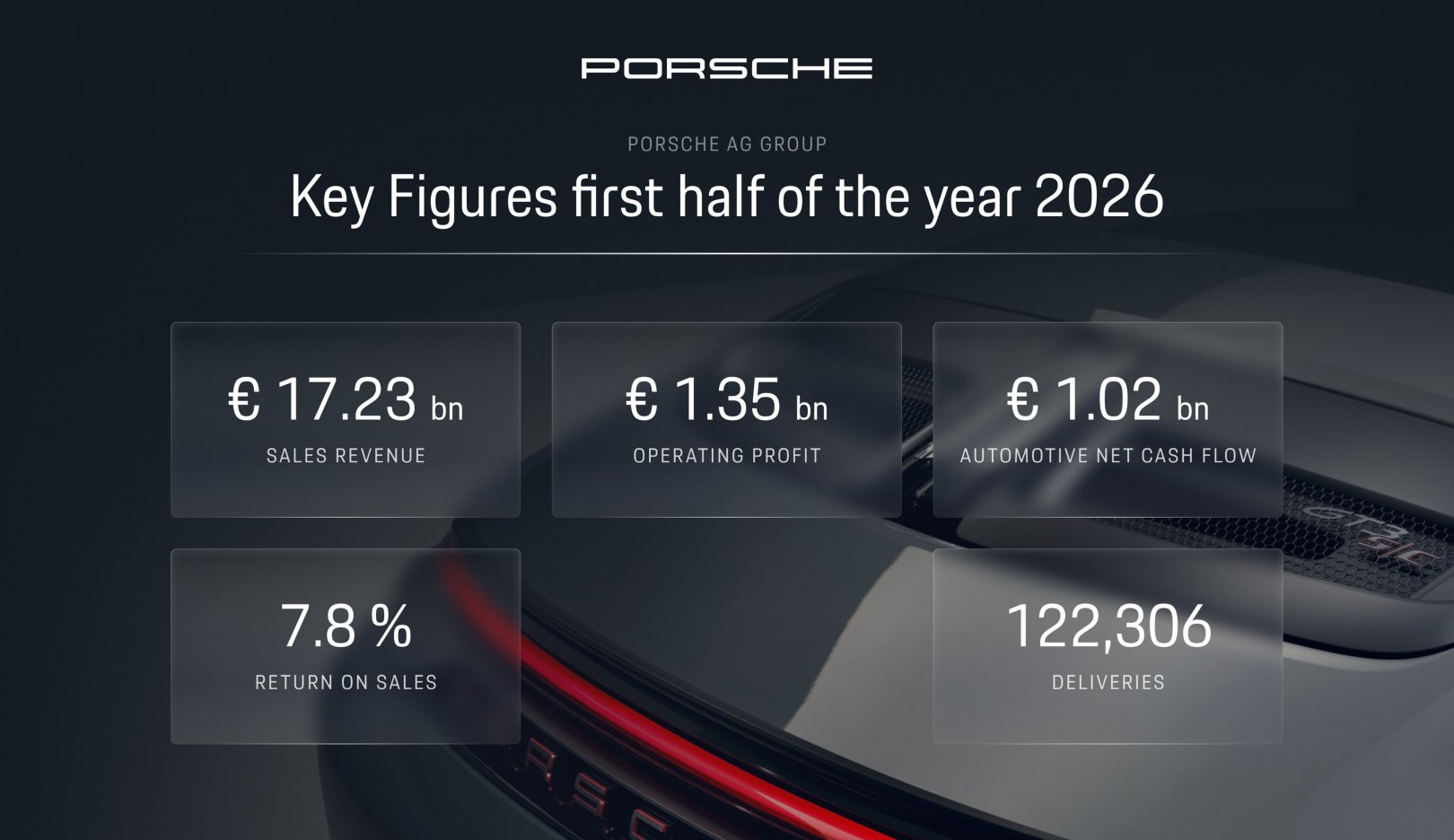
Porsche recorded revenue of €17.23 billion in the first half of 2026, compared with €18.16 billion a year earlier, a decline of 5.1 percent. Operating profit moved in the opposite direction, rising from €1.01 billion to €1.35 billion. The group’s operating return on sales increased to 7.8 percent from 5.5 percent.
Automotive net cash flow also strengthened, reaching about €1.02 billion compared with €394 million in the same period of 2025. Porsche said the improvement reflected higher operating cash inflows, disciplined working-capital management and lower investment outflows. Its automotive net cash-flow margin rose to 6.7 percent from 2.4 percent.
Those gains came alongside a substantial fall in deliveries. Porsche delivered 122,306 vehicles to customers, down from 146,391 in the first half of 2025, a decline of 16.5 percent. The company attributes the financial performance to cost management, pricing, product mix and its value-over-volume strategy. In practical terms, the release shows that stronger financial results did not come from selling more vehicles.
The electric share fell in the first half
The most important electric-mobility figure is less positive. Battery-electric vehicles represented 19.4 percent of Porsche’s automotive business in the first half of 2026, compared with 23.5 percent in the previous year. Porsche does not provide a battery-electric unit total in this release, so the published percentage should not be converted into an invented sales figure.
The company nevertheless left its full-year forecast unchanged. Porsche expects a battery-electric share of between 24 and 26 percent for 2026, alongside projected sales revenue of €35 billion to €36 billion and an operating return on sales of 5.5 to 7.5 percent. These are management targets, not results already achieved, and the company’s own release notes that they depend on economic, political and market conditions.
For readers following the EV market, the verified takeaway is therefore twofold. Porsche has improved profitability and cash generation during a difficult period, but the electric share of its business has not yet followed that financial recovery. The first-half data also does not explain how the BEV mix changed by model, region or powertrain, so broader conclusions about individual Porsche electric vehicles would go beyond the evidence in this announcement.
Realignment reaches the production network
Porsche’s financial reset is connected to a wider industrial plan. In a separate official announcement about its Future Package, the company said it plans cumulative investments of €2.1 billion in the Zuffenhausen and Weissach sites by 2035. The package extends employment and site protection through 2035, while also planning a socially managed reduction of a further 5,000 jobs by that point, mainly through natural attrition, demographic effects, partial retirement and voluntary severance agreements.
The arrangement is not presented as an EV-only investment programme. Porsche says it is intended to strengthen competitiveness, preserve production of two-door sports cars in Zuffenhausen and keep development activities for all model lines concentrated in Weissach. That distinction matters: the announcement confirms a long-term industrial restructuring, but it does not specify how much of the investment will be assigned to battery-electric programmes.
The first-half financial release also puts a cost on the transition. Porsche reported a net burden of about €100 million from strategic realignment measures in the first six months. It expects the costs associated with the Future Package to reach a three-digit-million-euro amount in the second half of 2026 and again in 2027. The figures are company estimates and should be read separately from the operating results already reported.
What Porsche is confirming next
The announcement confirms that Porsche is maintaining its 2026 guidance while pursuing a strategy focused on profitability, cash flow and resilience. It also confirms that the company is willing to accept lower volume as part of its value-over-volume approach. At the same time, the falling BEV share shows that the financial turnaround and the electric transition are moving at different speeds.
Porsche says it will provide a comprehensive explanation of its Sportwagenschmiede 35 strategy at a Capital Markets Day scheduled for 7 October. That event may clarify the future product and industrial priorities, but the current release does not pre-empt those details. For now, the official evidence supports a measured conclusion: Porsche has stabilised key financial indicators, yet its first-half electric mix declined and its next phase of electrification remains closely tied to a broader corporate reset.