
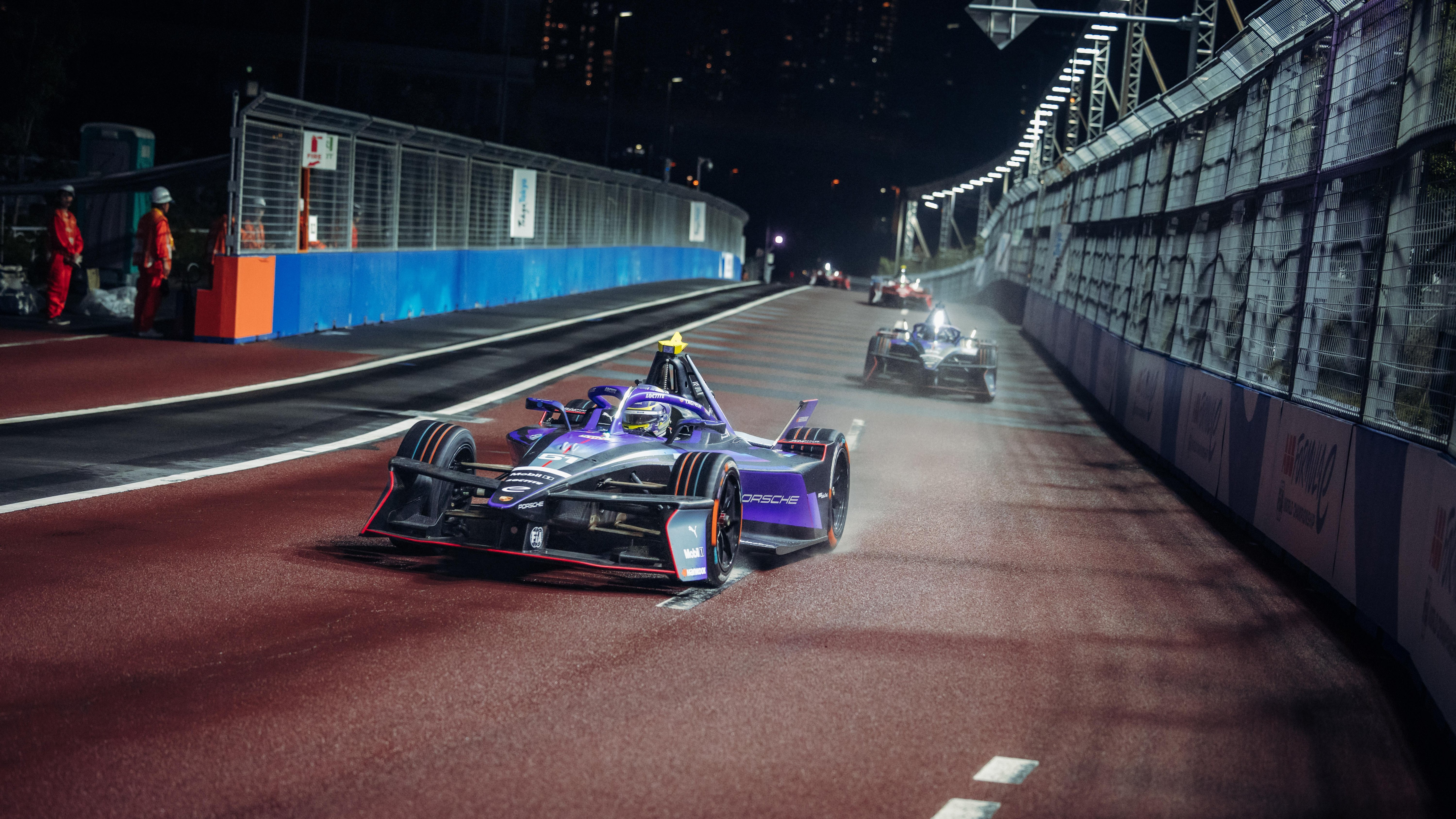
Porsche has retained the FIA Formula E Manufacturers’ World Championship, securing the title for a second consecutive season in the all-electric series. The result was confirmed after the Tokyo E-Prix and gives the German manufacturer another major championship win built across factory and customer teams.
According to Porsche’s official race report, points scored by Andretti Formula E driver Jake Dennis and Porsche factory driver Nico Müller were decisive. Dennis finished third after starting from 17th on the grid, while Müller finished seventh. Pascal Wehrlein, Porsche’s other factory driver, finished 14th.
A manufacturers’ title, not a clean sweep
The result needs to be read carefully. Formula E awards separate championships for manufacturers, teams and drivers. Porsche had secured the manufacturers’ crown, but the other two titles were still open when the announcement was made.
After 15 of the season’s 17 races, Porsche led the manufacturers’ standings with 448 points, ahead of Jaguar on 351 and Stellantis on 243. The manufacturers’ classification draws on the two highest-finishing cars from each brand in every race, meaning Porsche’s result reflects contributions from its factory entry as well as customer operations.
The teams’ standings were different. Jaguar TCS Racing led with 257 points, while the Porsche Formula E Team had 243. Andretti Formula E stood third among teams with 211 points, and Cupra Kiro was eighth with 116. That split illustrates why a manufacturer can win the overall technical championship without leading the separate team competition.
The drivers’ contest was also unsettled. Dennis moved into first place with 146 points, only two ahead of Jaguar driver Mitch Evans. Wehrlein was third on 141 points, while Müller was eighth on 102. The final two races were scheduled for London, leaving the driver and team championships to be decided separately.
How the Tokyo race shaped the result
Tokyo’s race was affected by wet conditions. The event began behind the Porsche Taycan Turbo GT safety car, followed by a standing start at the end of the opening lap. As the track dried, Dennis moved through the field from 17th. A late red flag limited his opportunity to use his remaining Attack Mode, and the race ended with a short sprint after the restart.
For Müller and Wehrlein, the changing surface created a different challenge. Both Porsche factory cars started with wet-weather setups and initially lost ground as the circuit dried. Müller later stopped for tyres suited to the changing conditions and recovered enough to score points. Porsche reported that those points helped reduce the factory team’s deficit to Jaguar.
The result was therefore not based on a single dominant finish. It came from a combination of customer-team performance, factory-team consistency and the scoring structure used across the championship. That distinction matters when assessing what the title says about Porsche’s Formula E programme.
What the title says about electric mobility
Porsche describes Formula E as a development environment for its production sports cars. Its Formula E overview says the company uses the all-electric championship to gain technical insights connected with electrification, sustainability and vehicle development.
That link should not be treated as proof that a racing result directly predicts the performance of a road car. Formula E cars use a championship-specific chassis and battery regulations, while production vehicles must meet different requirements for durability, comfort, safety, cost and everyday usability. A manufacturers’ title demonstrates competitive performance within the racing rules; it does not independently verify range, charging speed or efficiency for a consumer vehicle.
The more defensible conclusion is narrower. Formula E gives manufacturers a demanding environment in which energy management, electric-drive control, software and thermal performance are tested under competitive conditions. Porsche’s retained title shows that its combined factory and customer network produced the strongest manufacturers’ points total in this season’s championship at the time the title was secured.
The broader significance
Porsche’s 99X Electric also strengthened its position in the current GEN3 era. Porsche said the car had become the most successful GEN3 Formula E car by that point, with five of the ten world championship titles awarded during the era. That is a statement about the racing record of the 99X Electric, not a claim about the superiority of every Porsche electric road car.
For electric-mobility observers, the result is useful because it separates three issues often blended together in manufacturer announcements: championship success, technology transfer and consumer outcomes. The first is supported by the official standings. The second is Porsche’s stated rationale for competing. The third requires independent road-car data, which this announcement does not provide.
Porsche’s manufacturers’ title is therefore best understood as a verified motorsport result with a clear technical context. It confirms that Porsche retained the all-electric championship’s manufacturers’ crown, while leaving the remaining season outcomes and any wider conclusions about electric cars to separate evidence.