
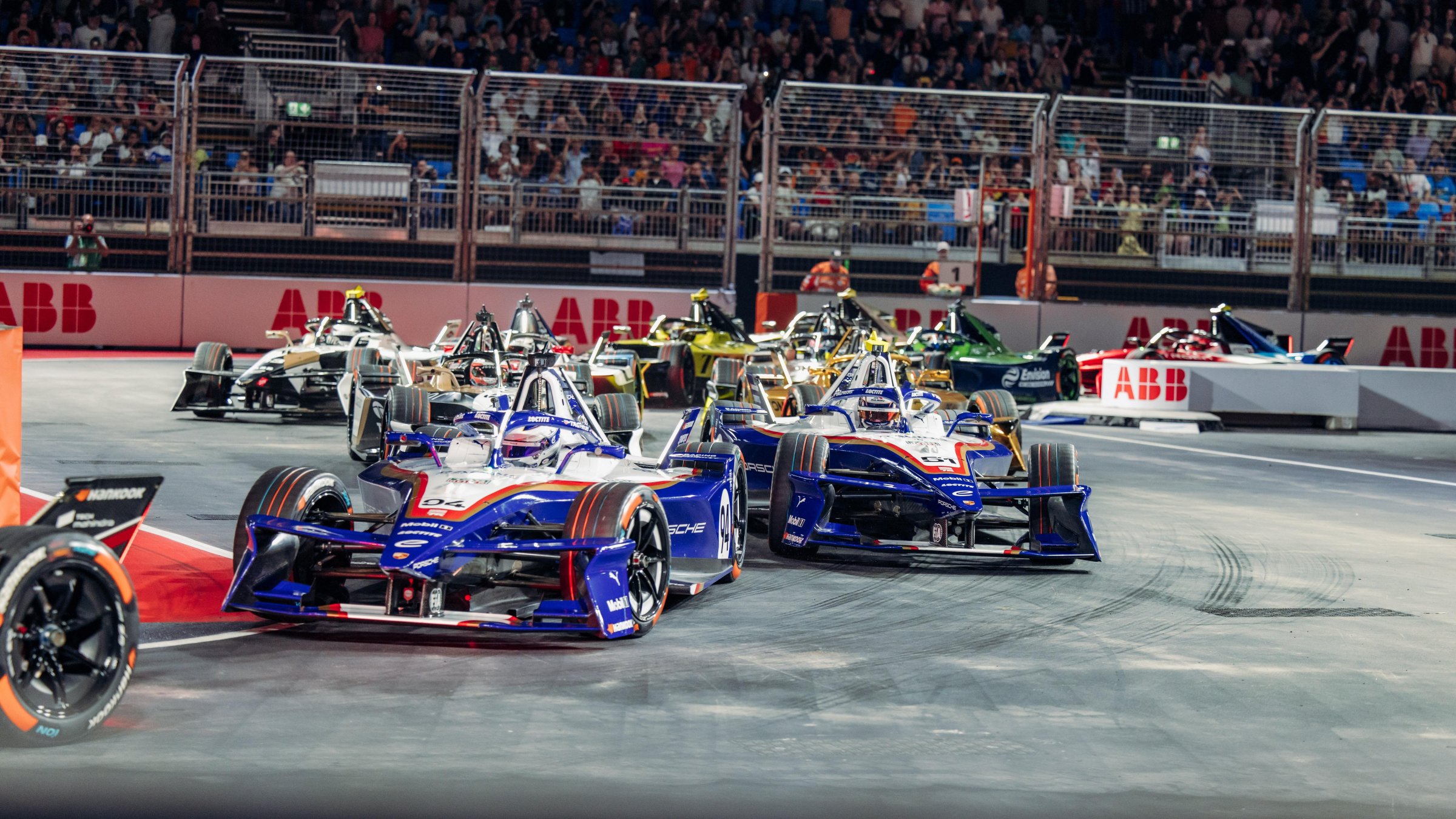
Porsche has ended Formula E’s 2025/2026 season with two major titles. In its official race report, the manufacturer confirmed that Pascal Wehrlein won his second Drivers’ World Championship at the London E-Prix, while Porsche retained the Manufacturers’ World Championship it had secured at the previous round in Tokyo.
What Porsche confirmed in London
Wehrlein finished 14th in the 35-lap London finale and did not score, but his season-long total of 169 points was enough to keep him ahead of Andretti Formula E driver Jake Dennis, who also uses Porsche technology. Dennis finished 18th in the final race and ended the campaign on 164 points. Jaguar’s Mitch Evans placed third in the final drivers’ classification with 160 points.
The result gives Wehrlein a second Formula E drivers’ crown. Porsche’s report says he recorded the most wins in the season, with three, and shared the leading totals for podiums and pole positions, with six and four respectively. He is now one of only two drivers to have won the Formula E drivers’ title twice, alongside Jean-Éric Vergne.
The London race itself was less straightforward than the final table suggests. Wehrlein and Porsche teammate Nico Müller started third and fourth, but both were pushed back during the race. Müller finished 12th. Dennis was also involved in a late incident, while the final result left Jaguar with the teams’ title. That separation matters: a driver can win the individual championship while the team classification goes elsewhere.
How Porsche kept the manufacturers’ title
Porsche had already secured the manufacturers’ championship at the Tokyo E-Prix, two races before the season ended. The final standings published in the report show Porsche on 498 points, ahead of Jaguar on 400 and Stellantis on 292. Jaguar finished first in the teams’ classification with 288 points, while the Porsche Formula E Team ended second on 271.
Formula E’s manufacturers’ table is built around the two highest-finishing cars from each manufacturer in every race. That structure means Porsche’s result was not produced by its factory entry alone. Andretti Formula E and CUPRA KIRO, both customer teams running Porsche 99X Electric technology, also contributed points during the season. Porsche’s announcement presents that customer-racing network as a central part of the title.
It is a useful distinction for anyone following electric motorsport as part of the wider mobility industry. The championship result measures performance in a tightly defined all-electric racing series, but it also shows how a manufacturer’s technology programme can extend beyond its works team. The official report does not claim that a racing result directly predicts the efficiency, charging performance or durability of a road car, and there is no basis here for making that leap.
The 99X Electric closes the GEN3 era
Porsche says the 99X Electric ends Formula E’s GEN3 era as the most successful car of that generation. The manufacturer counts six of the ten world championship titles awarded during the era, along with 16 race wins for the factory team and 23 victories when customer teams are included. Those are campaign statistics supplied by Porsche in the announcement, not an independent product test.
The result also gives the electric race car a place in Porsche’s longer engineering story. The company says Formula E provides insights for its production sports cars, while Motorsport Vice President Thomas Laudenbach described the programme as a way to remain at the top of electric motorsport. The report does not identify a particular road-car component or software feature that came directly from this season, so the confirmed takeaway is the existence of the development link rather than a specific consumer benefit.
Why this is relevant beyond the podium
For the electric-mobility sector, the announcement is less about a new vehicle than about what manufacturers are using competition to validate. Formula E provides a public setting for battery-electric powertrains, energy management, software strategy and operational decision-making under changing conditions. Porsche’s Tokyo title and London drivers’ crown show a programme that performed consistently across a full season, including through a switch from the GEN3 era to the next generation of cars.
There is also a clear limit to the story. Porsche’s announcement does not provide pricing, production plans, charging specifications or availability for a consumer vehicle. It does not establish that a Porsche road car is faster, more efficient or more reliable because the racing team won. Its verifiable news value is narrower and stronger: Porsche retained the manufacturers’ championship, Wehrlein won the drivers’ title, Jaguar took the teams’ crown, and the 99X Electric finished its generation as the manufacturer’s most successful single-seater.
That balance is important as electric motorsport becomes part of the wider automotive technology conversation. A championship can indicate sustained execution in a competitive electric series, while the transfer to everyday mobility still has to be demonstrated through road-car data, independent testing and real-world customer use. For now, Porsche’s London report confirms a successful end to its GEN3 campaign and sets the stage for the company’s next Formula E chapter.