
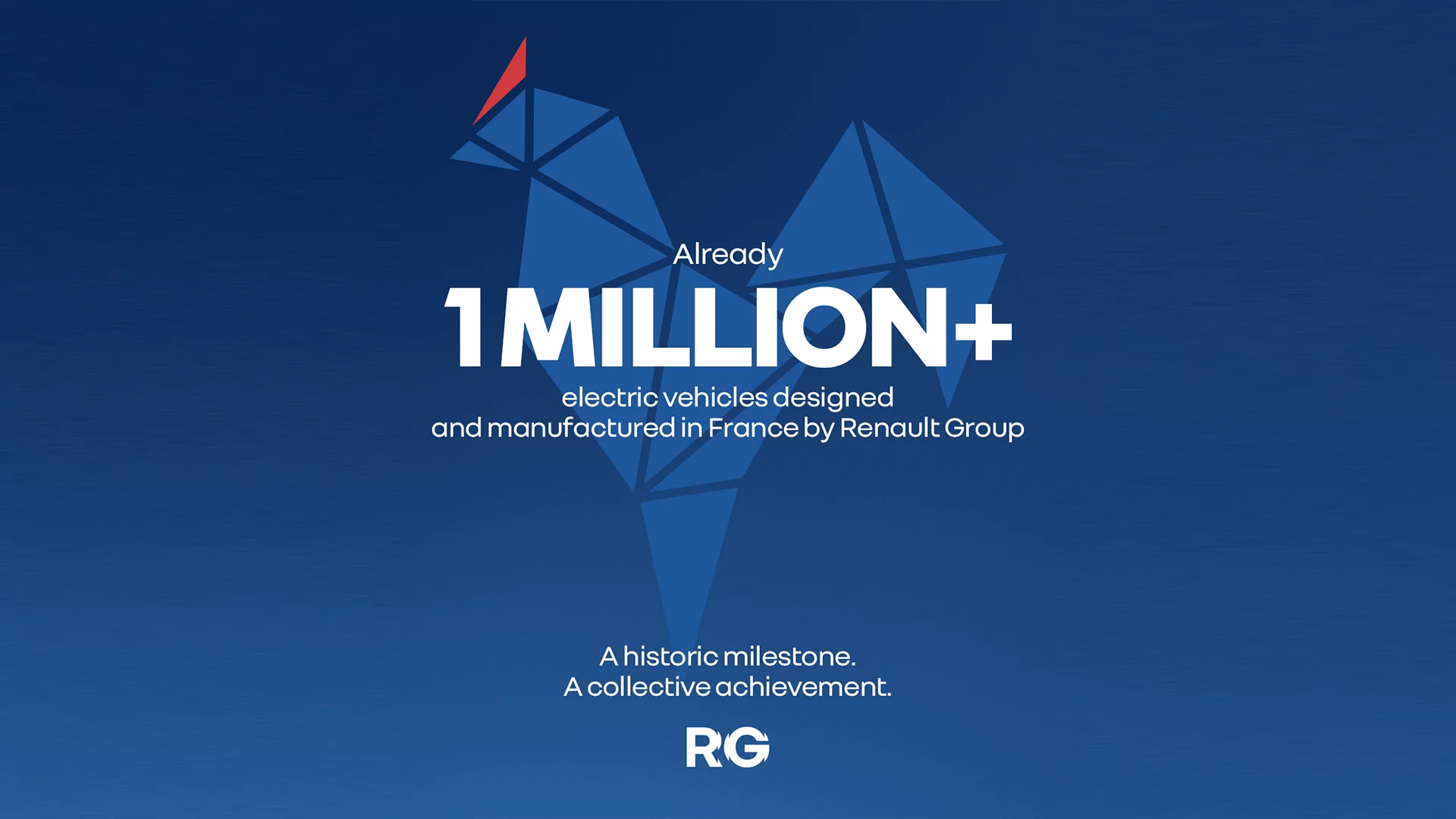
Renault Group says it has passed a significant industrial milestone: more than one million electric vehicles have now been designed and produced in France since 2010. The announcement underlines how electric mobility has moved from a long-term technology programme to an established part of the company’s manufacturing footprint.
According to Renault Group’s official announcement, the total includes 600,000 electric vehicles produced through Electricity, the group’s electric industrial hub in northern France. The wider figure covers vehicles made across a network of assembly, bodywork, mechanical and circular-economy sites.
A national production network
The milestone is spread across several French locations rather than being concentrated at a single plant. Renault Group identifies Douai, Maubeuge, Dieppe, Batilly and Sandouville among the production sites involved, alongside mechanical facilities in Cléon, Ruitz and Le Mans. The Flins Refactory, which focuses on circular-economy activities, is also part of the group’s broader industrial transition.
This network supports several types of electric vehicle. Kangoo E-Tech electric and Master E-Tech electric are part of Renault Group’s electric light-commercial-vehicle range, while the company’s passenger-car production in northern France includes the Renault 5 E-Tech electric and Renault 4 E-Tech electric. The announcement presents that breadth as evidence that electrification is being integrated across different vehicle segments and factory operations.
Renault Group also says that its French sites are increasingly serving multiple brands and partners. Electricity’s facilities produce vehicles for Renault and Alpine, with production for Nissan and Mitsubishi already part of the industrial arrangement. The group says the hub is expected to add Ford production in the future, further expanding the role of northern France in its European manufacturing strategy.
Investment, employment and skills
The company says it has invested €13 billion since 2021 to transform its French operations and build a domestic electric-vehicle value chain. Renault Group has indicated that a further €13 billion could be invested as part of its futuREady plan, provided the necessary conditions are in place. That qualification matters: the additional amount is a stated intention rather than a completed investment.
The industrial change also has a significant employment dimension. Renault Group reports nearly 39,000 employees in France and around 35,000 indirect jobs supported through its supply chain. It also says that 53,000 employees have been trained through Reknow University in areas including electrification, battery technology, artificial intelligence and the circular economy.
Those figures illustrate one of the less visible consequences of the EV transition. Moving from combustion-engine production to electric vehicles requires new expertise in high-voltage systems, software, battery assembly, energy management and vehicle refurbishment. Renault Group’s announcement links the production milestone to this wider effort to renew industrial skills rather than treating electric vehicles as a simple change of powertrain.
What comes next for Renault’s electric factories
The company’s next phase will include a stronger focus on electric commercial vehicles. Renault Group says the new Trafic E-Tech electric is planned for the end of 2026 and describes it as part of its intention to become the first European carmaker to introduce a software-defined vehicle in the light-commercial-vehicle segment.
The northern production hub is also continuing to increase output. Renault Group says the Renault 5 production line passed 100,000 vehicles by the end of 2025 and is targeting more than 200,000 units since launch. The company further reports that the 600,000-vehicle Electricity milestone has been accompanied by new permanent positions and additional recruitment to support rising activity.
These announcements are company-reported figures, but they provide a clear view of Renault Group’s chosen industrial direction. Rather than relying only on imported electric vehicles or isolated model launches, the group is building an integrated French ecosystem around vehicle assembly, mechanical components, workforce training and circular-economy operations.
The one-million-vehicle milestone therefore matters beyond the headline number. It shows the scale already reached by Renault Group’s French EV manufacturing base and sets a reference point for the next stage of its strategy: expanding electric production across passenger cars and commercial vehicles while keeping more of the engineering, manufacturing and skills development inside the European industrial network.