
Volkswagen Classic announced two first-generation Golf GTIs for the 2026 Bremen Classic Motorshow, held from January 30 to February 1, 2026. The cars were presented at stand D08 in Hall 5, alongside Volkswagen Commercial Vehicles Oldtimer, Audi Tradition and Autostadt Wolfsburg.
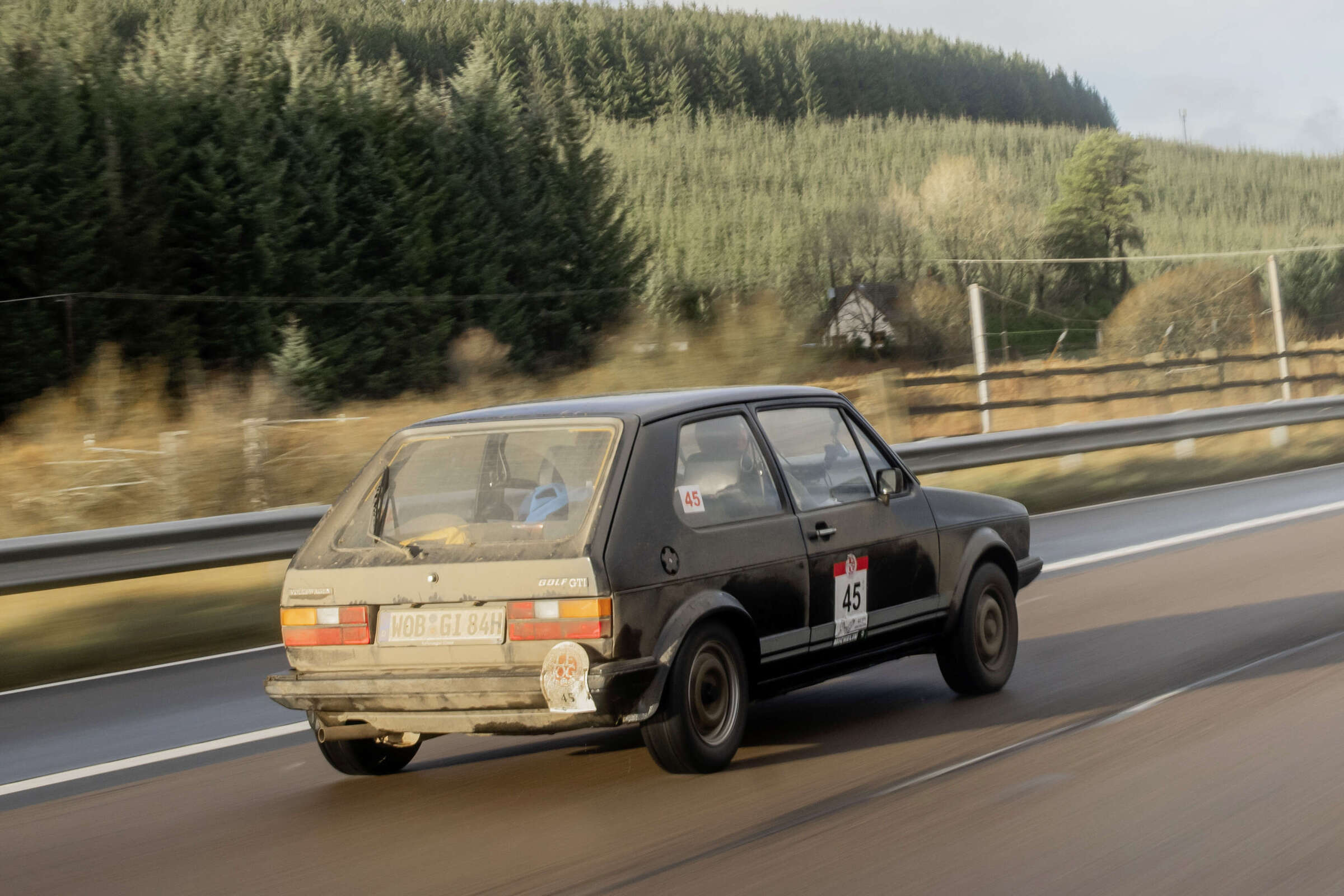
The Volkswagen Newsroom announcement pair consisted of a Mars Red Golf I GTI from 1979 and a Brilliant Black Golf I GTI from 1983. The black car retained its original rally patina, preserving the condition in which it completed a demanding event instead of presenting a freshly restored finish.
The 1983 GTI kept the marks of the LeJog rally
The 1983 car’s story is tied to the LeJog rally, a 1,500-mile route covering about 2,400 kilometres across the United Kingdom. The event runs from Land’s End in south-west England to John O’Groats in northern Scotland over four days.
Volkswagen said the car used for the rally was a near-production 1983 Golf I GTI. It was shown in the same state in which it crossed the finish line in Scotland, making the visible wear part of the display rather than something to be removed during restoration.
That distinction gave visitors two ways to read the car. It remained recognisable as a road-going Golf GTI, but its condition also carried the evidence of a specific endurance story. The presentation described a model close to series specification, not a heavily modified competition machine.
How the Golf GTI outgrew Volkswagen’s original plan
The first Golf GTI developed 81 kW, equivalent to 110 hp. Its identity was also defined by details that quickly became recognisable, including a red outline around the grille, black wheel-arch extensions and a gear lever topped with a golf-ball-shaped knob.
Volkswagen initially expected to build 5,000 GTIs. Dealers sold ten times that planned volume in the first year, and production of the first-generation Golf GTI eventually reached 461,690 cars. Volkswagen says more than 2.5 million Golf GTIs have been produced overall.
Those figures explain why the Bremen display focused on more than two old cars. The 1979 and 1983 examples represented the model’s early identity, while the production figures showed how far the GTI’s appeal extended beyond Volkswagen’s first forecast.
A heritage display, not a new vehicle announcement
The Bremen appearance concerned a public exhibition of historic cars rather than a new vehicle launch. Its interest lay in the pairing of two first-generation examples and in the preserved rally condition of the 1983 car.
The organisers expected around 50,000 visitors, giving the display a sizeable public setting. That audience did not change the cars’ status as historic examples, but it placed the original Golf GTI formula—compact performance, distinctive trim and a clear motorsport connection—directly in front of a broad classic-car crowd.
Volkswagen Classic’s presentation therefore connected two reference points: a 1979 Golf I GTI representing the early road-car identity, and a 1983 GTI carrying the patina of its LeJog finish. Together, they showed the model’s original design and performance formula before setting it against the scale the nameplate ultimately reached.