
Volkswagen’s volume-brand division is reporting a better first-half financial result while its new entry-level electric-car programme begins to generate measurable demand. In its official first-half release, the Brand Group Core says it received more than 70,000 orders for the new Electric Urban Car Family, even as the group continues to cut complexity and reorganise how its brands work together.
A stronger result, but not a clean sweep
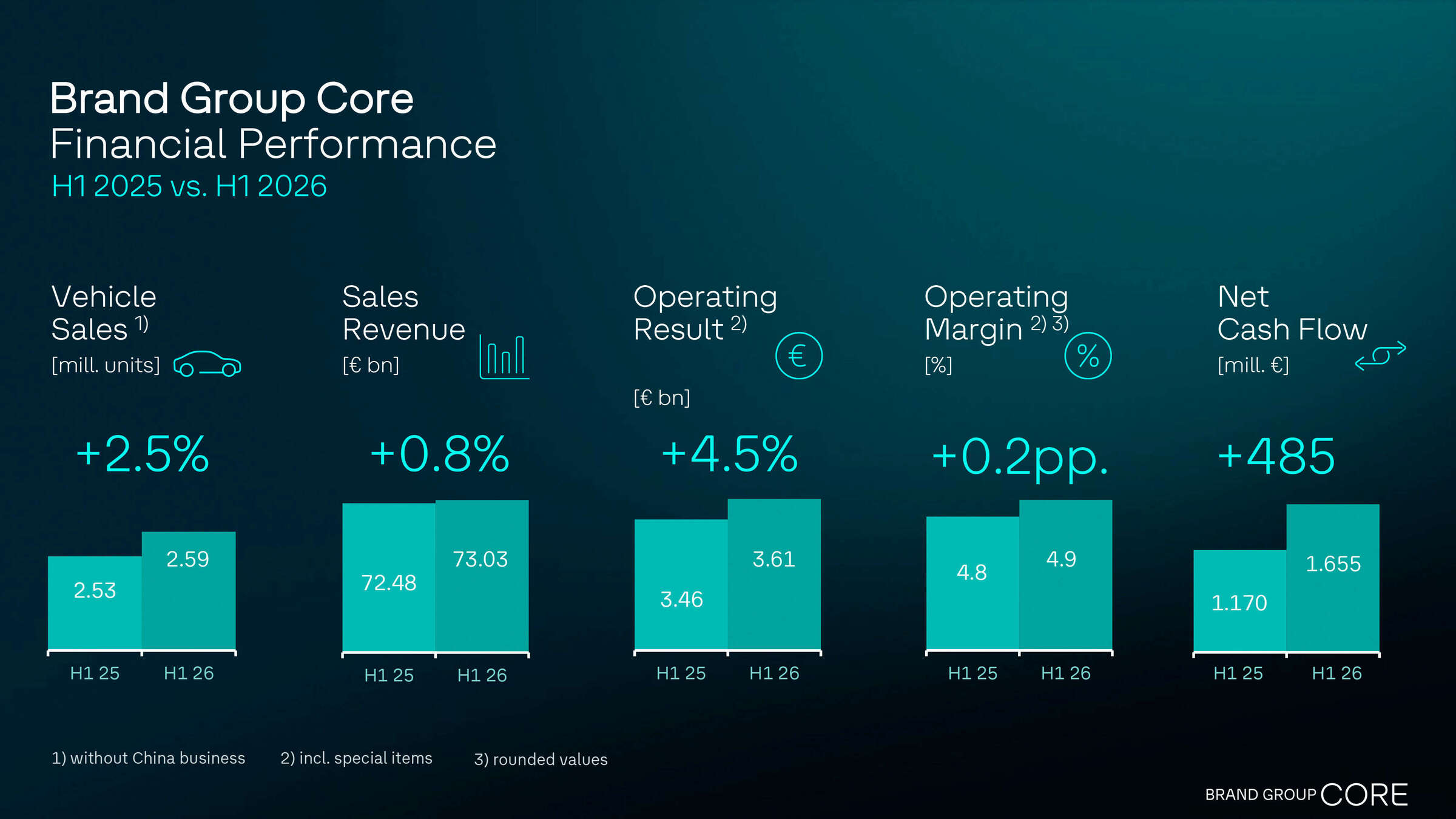
The Brand Group Core combines Volkswagen Passenger Cars, Škoda, SEAT and CUPRA, and Volkswagen Commercial Vehicles. It recorded an operating result of €3.61 billion in the first half of 2026, up 4.5% from the same period a year earlier. The operating margin edged up from 4.8% to 4.9%.
Sales revenue rose 0.8% to €73.035 billion, while unit sales increased 2.5% to 2.59 million vehicles, excluding the Chinese business from the vehicle-sales comparison used in the release. Net cash flow also improved, reaching €1.655 billion compared with €1.170 billion in the first half of 2025. Those figures point to incremental progress rather than a broad-based surge: revenue grew more slowly than vehicle sales, and the company says the result still falls short of its own ambitions.
Volkswagen attributes the improvement to cost programmes, tighter control of inventories and investment, and closer cooperation among the volume brands. The backdrop remains difficult. The company cites US import tariffs, geopolitical disruption, trade barriers, regulatory requirements and heightened competition as pressures on markets and supply chains.
Electric orders are the clearest mobility signal
The most relevant figure for the electric-mobility transition is not a delivery total but the order book. Volkswagen says more than 70,000 orders have been received for the Electric Urban Car Family, a group of smaller battery-electric models positioned at the entry level. At the time of the update, three of the four planned models were available: the CUPRA Raval, Volkswagen ID. Polo and Škoda Epiq.
That distinction matters. An order is an indication of customer demand, not proof that a vehicle has been built, delivered or retained by the customer. The release does not provide a cancellation rate, a country-by-country order breakdown or a delivery timetable for the full family. It does, however, identify the new models as a positive signal inside a wider business that is still managing high competitive and regulatory pressure.
The company also points to strong demand for existing battery-electric models, particularly the Volkswagen ID.3 and Škoda Elroq. Volkswagen does not present the 70,000-order figure as a market-wide measurement, so it should be read as a company-reported indicator of early interest in its own portfolio rather than as evidence that the entire European EV market has moved in the same direction.
A new operating model behind the product push
The financial update is also an organisational announcement. A new Core Executive Committee began work in July, bringing together the chief executives of the four volume brands with the leaders responsible for finance, procurement, production and technical development. Volkswagen says the structure is intended to give the group clearer responsibilities, fewer interfaces and more regional control.
The practical objective is to share scale without erasing the identities of the individual brands. The group estimates that the revised production steering model could create cumulative savings potential of €1 billion through 2030 in production alone. That is a forward-looking estimate, not a saving already booked in the first-half result. Its impact will depend on implementation, plant decisions and the ability to coordinate product and manufacturing plans across brands.
What the brand figures add to the picture
Volkswagen Passenger Cars sold 1.53 million vehicles in the first half, excluding China. Its operating result fell to €995 million from €1.103 billion a year earlier, with the company citing the cost of restructuring and the discontinuation of ID.4 production in Chattanooga among the adverse effects. After excluding those special items, the brand reports an operating margin of 3.8%, compared with a reported 2.4%.
Škoda was the strongest growth contributor within the group, with unit sales up 8.2% and an operating result of €1.366 billion, up 6.3%. Volkswagen Commercial Vehicles says its battery-electric share continued to increase and reports a 23.2% market share in the BEV segment. These figures show why the group is presenting electrification as a multi-brand programme: the financial contribution and sales momentum are distributed across different nameplates and markets.
The verified takeaway
Volkswagen’s announcement supports a measured conclusion. The Brand Group Core improved its first-half profitability and cash flow, while its smaller electric-car family has attracted a substantial number of early orders. At the same time, the company remains exposed to tariffs, competition, restructuring costs and uneven regional demand. The release confirms a strategy being executed under pressure; it does not establish that the new models will meet their planned production scale or that the order figure will translate directly into deliveries.
For readers tracking electric mobility, the useful development is the combination of a concrete order figure and a structural response from one of Europe’s largest automotive groups. The next meaningful checks will be deliveries, production ramp-up and whether the claimed efficiency gains appear in later reporting. Until then, the official figures support cautious optimism about demand for more affordable electric models, not a verdict on the programme’s final success.