
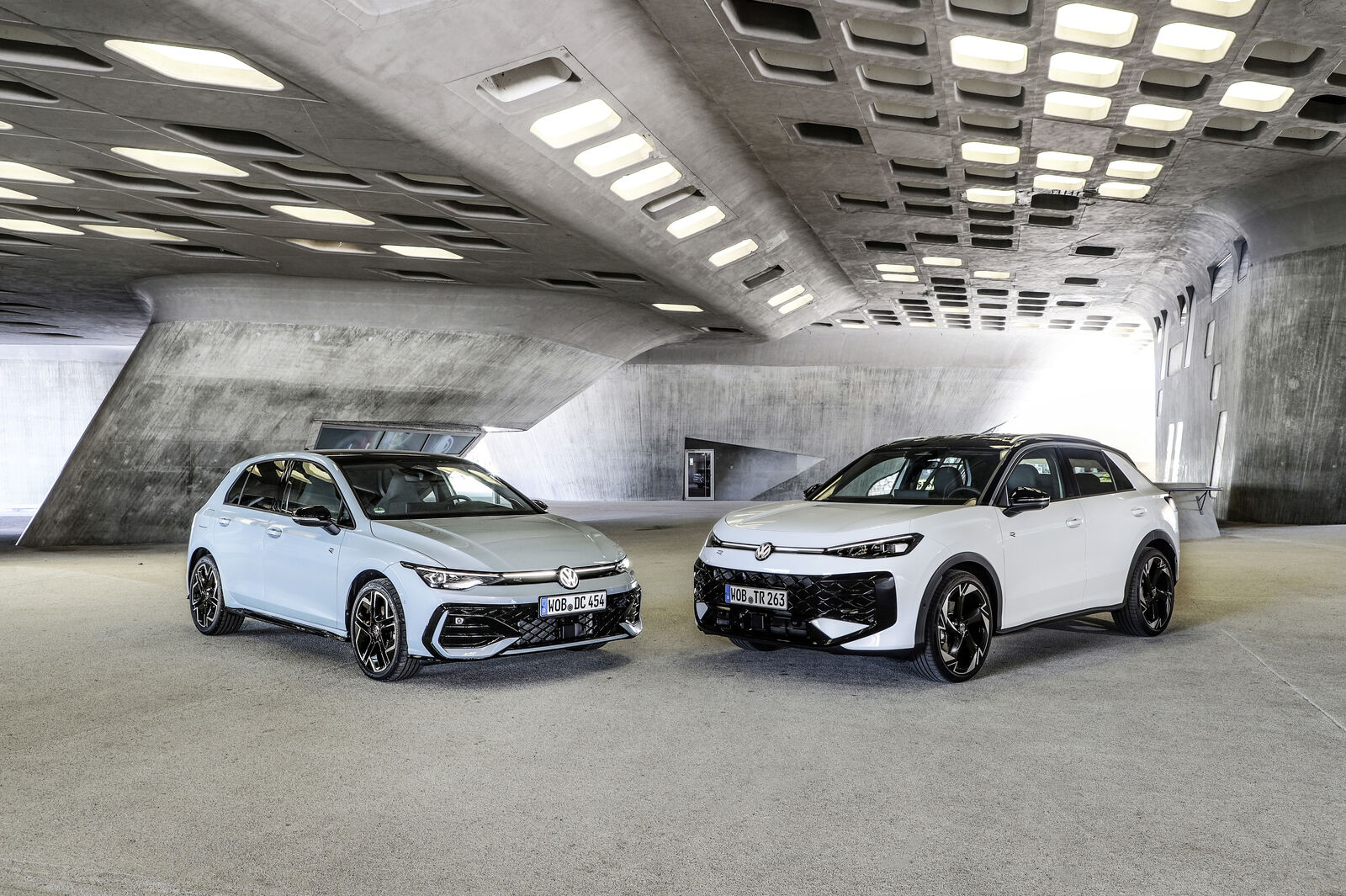
Volkswagen says the Golf Hybrid and T-Roc Hybrid are due to receive a new full-hybrid system from the fourth quarter of 2026. It is designed to provide temporary electric propulsion without a charging cable or external charging infrastructure, while retaining a turbocharged petrol engine.
Start with the planned launch window
Volkswagen announced the plan in a 23 April 2026 press release. The company had planned to present the system’s details at the Vienna Motor Symposium, held from 22 to 24 April 2026. The fourth-quarter timing is a planned introduction window, not confirmation that every market, specification or price will arrive at the same time.
The confirmed change is the addition of a full-hybrid powertrain option for the Golf and T-Roc. A single launch date for every country has not been established, so regional availability will need to be checked in later Volkswagen information.
Electric propulsion does not mean electric range
Volkswagen describes a system that can drive the vehicle electrically without requiring the driver to plug it in. Energy is recovered through regenerative braking and can also be produced on board when the turbocharged petrol engine works with a generator.
That confirms the energy path, not the duration of electric driving. The announcement provides no battery-only distance, electric operating time, charging time or maximum electric speed. Temporary electric propulsion should therefore not be read as a promise of a defined electric range.
What sits inside the powertrain
The system combines a hybrid module, a turbocharged TSI petrol engine and a lithium-ion battery. The hybrid module contains a traction electric motor and a second electric motor that acts as a generator. These machines have different jobs; they are not two independent driving systems.
The high-voltage battery uses NMC cells and has a gross capacity of 1.6 kWh. Volkswagen says it is installed beneath the rear floor in both models. That tells you where the battery is located and gives its gross capacity, but neither detail establishes how far the vehicle can travel electrically.
The useful distinction is between propulsion, energy production and storage. The traction motor can move the vehicle, the generator can produce electricity from the running TSI engine, and the battery stores electrical energy beneath the rear floor.
How the three operating modes divide the work
- Electric mode: at low speed, the electric motor alone drives the vehicle while the TSI engine is switched off. This confirms temporary electric movement, not a guaranteed distance or a permanent engine-off condition.
- Sequential mode: the electric motor provides propulsion while the decoupled TSI engine generates energy through the generator. Here, the petrol engine is producing electricity rather than directly driving the vehicle.
- Parallel mode: at roughly 60 km/h on regional roads and motorways, the TSI engine becomes the main propulsion system and the electric motor assists acceleration. “Roughly” is important: the announced threshold should not be treated as an exact universal switch point in every driving situation.
Together, these modes explain how Volkswagen can offer electric propulsion without an external charger. Electricity can be recovered, stored or generated aboard the vehicle, while the petrol engine remains available when the system moves into parallel operation.
Keep the T-Roc figures model-specific
Volkswagen announces two power levels and says fuel consumption is lower than with a comparable mild-hybrid system. That is a directional comparison, not a published consumption result. Without an official test-cycle figure, it cannot be converted into a specific saving or used to predict real-world economy.
For the T-Roc 1.5 Hybrid, Volkswagen’s technical drive-systems page lists outputs of 100 kW (136 PS) and 125 kW (170 PS). It also specifies front-axle drive. These are the concrete T-Roc details available here and should not automatically be applied to every Golf Hybrid version.
The trade-off is clear in the architecture. The system adds temporary electric propulsion and is presented as more economical than a comparable mild hybrid, but it still relies on an onboard petrol engine and has no stated battery-only range.
What to check before comparing versions
- Keep the 23 April 2026 announcement date separate from the planned fourth-quarter introduction window.
- Check the exact model and power level. The 100 kW and 125 kW figures are confirmed here for the T-Roc 1.5 Hybrid.
- Confirm the drive layout. The cited T-Roc technical information specifies front-axle drive.
- Read “electric propulsion” together with “temporary.” Do not infer a battery-only range, charging time or engine-off duration that Volkswagen has not supplied.
- For fuel economy, wait for an official figure rather than turning the mild-hybrid comparison into a percentage.
For a driving or purchase decision, use the final market-specific technical information and operating documentation when Volkswagen publishes it. Until then, the firm picture is limited to a new full-hybrid system for the Golf and T-Roc, two stated T-Roc power levels, front-axle drive for the cited T-Roc version, and three operating modes.
Volkswagen’s plan changes the propulsion options expected for these two models from the fourth quarter of 2026. It does not confirm plug-in charging or a defined electric range, so the meaningful comparison will depend on the final market details, consumption figures and model-specific specifications.