
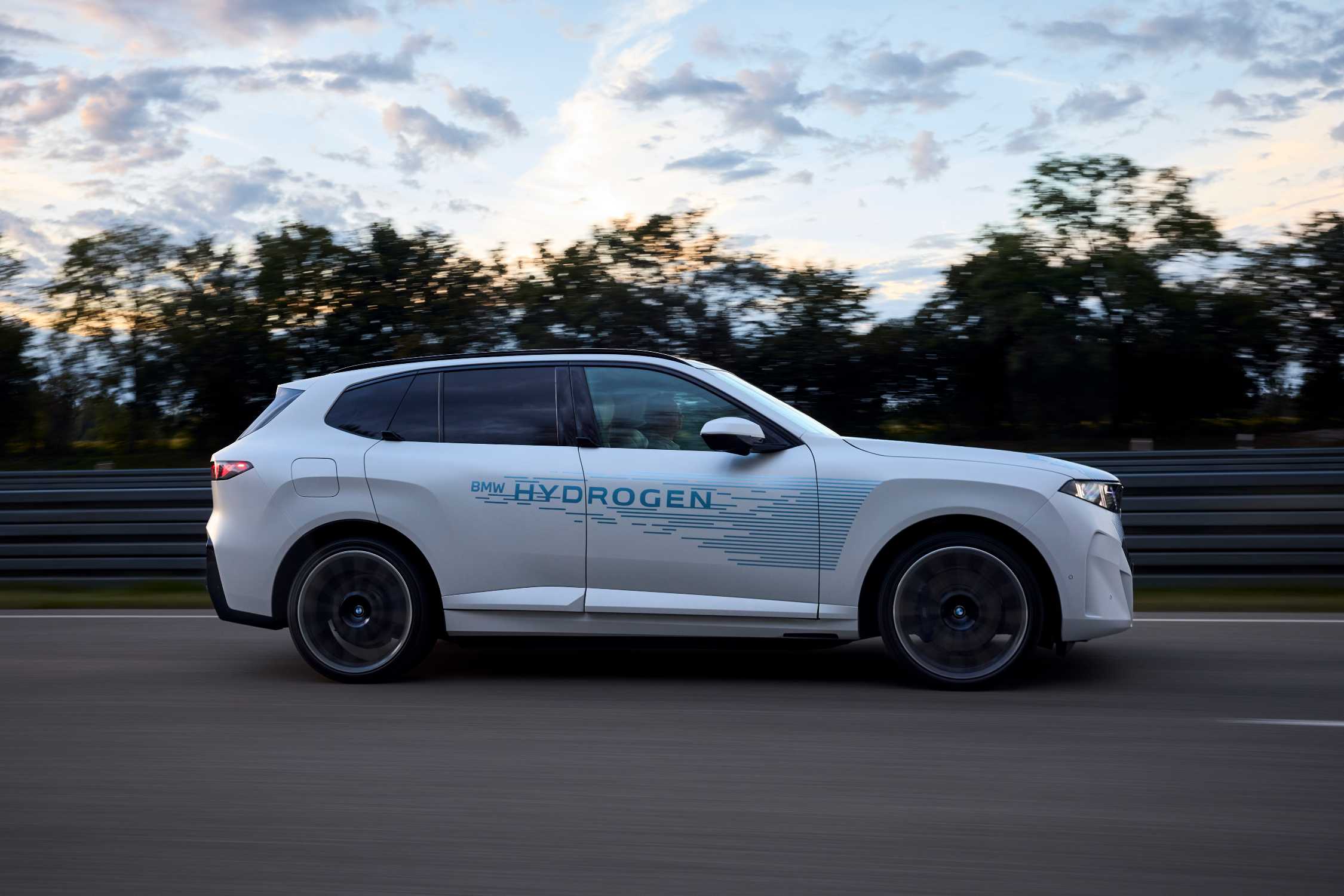
BMW said on September 10, 2026, that its current iX5 Hydrogen prototypes have entered a full road-testing programme. The company is advancing fuel-cell assembly in Munich at the same time as it prepares production equipment and staff in Austria, moving the vehicle from prototype validation toward industrial preparation.
Road testing will examine the complete system in demanding environmental and operating conditions. BMW is assessing how the integrated components behave under high load, including the fuel-cell stack, electric motor, high-voltage battery, hydrogen tanks, BMW Hydrogen Flat Storage and the Energy Master, which controls the high-voltage system.
Testing the complete hydrogen-electric system
BMW says the high-voltage battery and Energy Master allow more energy recuperation, improving the system’s overall efficiency. The company is targeting acceleration from 0 to 100 km/h in less than five seconds, with driving performance comparable to the BMW iX5. These are development objectives rather than confirmed production specifications.
The iX5 Hydrogen is also being developed around a targeted WLTP range of up to 750 kilometres, refuelling in less than five minutes and fully electric driving. BMW has not provided a contractual WLTP consumption figure because the vehicle remains a prototype. The range, refuelling time and acceleration figures therefore describe the current targets for development, not a final customer vehicle.
At BMW’s Hydrogen Competence Centre in Munich, the third-generation fuel-cell system has entered a new prototype-assembly phase. As BMW explains in its update, this stage is intended to finalise and validate the testing method while preparing the manufacturing process for industrialisation. The preceding prototype phase focused on component manufacturability and initial supplier qualification.
Munich and Steyr prepare the next phase
Munich and Steyr are developing and assembling the prototypes, while additional components are manufactured in Landshut. BMW says the Steyr plant has received its first test benches and manufacturing equipment. Employees are being trained progressively for industrialisation and a production ramp-up, with future series production of the fuel-cell systems planned for Steyr.
The iX5 Hydrogen powertrain and tank system are supported by Germany’s Federal Ministry of Transport through the HyPowerDrive project and the IPCEI Hy2Move programme. BMW cites €191 million in federal funding and €82 million from Bavaria.
What this update confirms
BMW intends the iX5 Hydrogen to become the BMW Group’s first production hydrogen model after the successful global trials of its pilot fleet. The current update connects vehicle testing with factory preparation, but it does not confirm that series production has started or that the vehicle is ready for customers.
BMW has not provided a series-production start date, price or market availability in this update. For now, the confirmed change is the coordinated move into road testing, prototype assembly and industrial preparation. Whether the combination of fully electric driving, a targeted long range and rapid refuelling reaches production will depend on the development work still underway.