
A study by E3 commissioned by GM Energy estimates that vehicle-grid integration could represent about $7 billion in annual national market value in the United States by 2030. Published on July 22, 2026, the analysis covers managed electric-vehicle charging (V1G) and bidirectional charging (V2G), including situations in which an EV is paired with residential solar and home storage.
What the $7 billion estimate includes
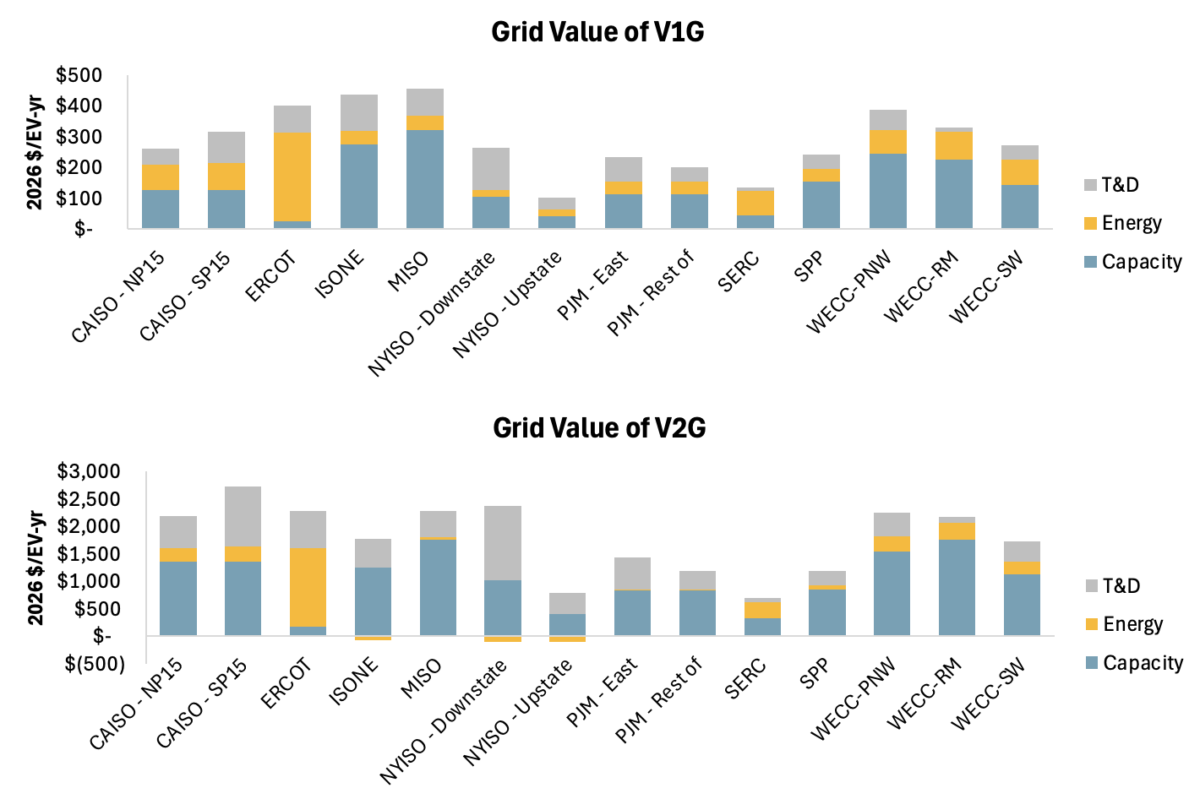
E3 assessed the network and customer value of V1G and V2G across U.S. electricity markets. At the vehicle level, it estimates annual network value in 2030 at $100 to $450 for V1G and $680 to $2,750 for V2G. These ranges describe potential system value associated with each vehicle. They are not a guaranteed payment or a standard return for every EV owner.
The study also places the projection against an existing fleet. E3 says GM already has a quarter of a million V2G-compatible vehicles in circulation in the United States. That gives the analysis a live vehicle base to consider, although the national estimate extends beyond GM’s fleet, any single utility, or one customer program.
Capacity and grid infrastructure drive much of the value
E3 expects most of the battery value in 2030 to come from capacity and transmission-and-distribution benefits rather than energy arbitrage alone. The opportunity, in other words, is not limited to charging when electricity prices are lower and using or returning energy when prices rise. It also depends on whether connected vehicles can help address broader electricity-system needs.
To model those outcomes, E3’s RESHAPE-EV model simulates charging profiles using driving behavior from thousands of drivers. The model accounts for home-charging access, vehicle type, and charging costs by location and time. E3 combines its forecasts of 2030 market prices with regional forecasts for EV adoption, then uses those inputs to extrapolate value per vehicle nationally.
That method matters because the same vehicle may have very different value depending on when it is available, where it is connected, and which grid services local markets can recognize. The national figure is therefore an estimate of potential market value across varying conditions, not a single tariff that can be applied everywhere.
Local utility design will determine the customer benefit
The utility examples in the study are more measured than the headline market figure. In all three cases E3 examined, managed charging reduced the customer bill. V2G outcomes varied by utility, while illustrative compensation based on wholesale energy prices produced returns too small to materially change customer bills.
Paying the full retail rate could improve the calculation for participating customers, but E3 warns that this approach can shift costs to other customers. The retail rate includes fixed charges that a participating customer may avoid even though the utility does not avoid those costs. The result is a direct tension between making participation attractive and keeping the wider cost allocation fair.
Regional market structure is another constraint. E3 identifies capacity markets and Resource Adequacy mechanisms as potentially strong opportunities for vehicle-grid value, but access to those mechanisms differs by location. For drivers, utilities, and households with solar or storage, the practical question is not simply how much value a connected battery can provide. It is how a local program measures that value, compensates the customer, and prevents the remaining costs from moving elsewhere in the system.
For now, E3 says most vehicle-grid value is captured through pilot programs. Its study points to a possible direction for EV energy services rather than a confirmed nationwide benefit available on identical terms. The $7 billion projection signals the scale of the opportunity; the customer case will depend on the utility and market rules that turn that potential into an actual program.